
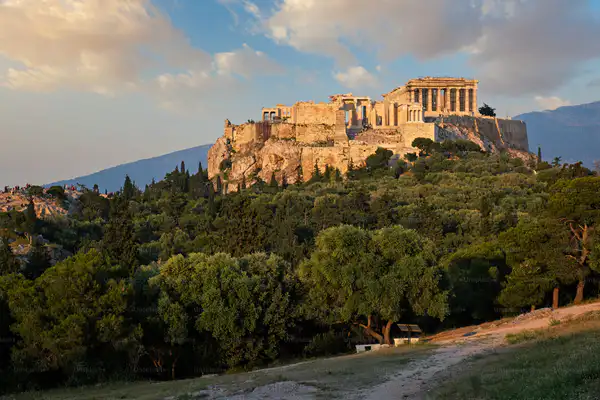
Two gods wanted the same city. Athena, goddess of wisdom, and Poseidon, god of the sea, both looked at the same rocky hilltop in Greece — the future Acropolis of Athens — and each said: that one’s mine. Neither would back down. So Zeus, king of the gods, set up what might be the highest-stakes contest in all of mythology: each god would offer the city a gift, and the people would pick a winner. Whoever gave the better gift would become the city’s protector — forever.
Poseidon went first, and he didn’t do subtle. He lifted his trident — a massive three-pronged weapon — and slammed it into the bare rock of the Acropolis. The stone cracked open and salt water came rushing up, a spring connected to the ocean itself. His pitch was raw power: choose me, and you’ll rule the seas. Your ships will dominate every trade route. Your navy will be untouchable. It was loud, dramatic, and impossible to ignore.
Then Athena stepped up. No earthquake, no theatrics. She knelt, pressed her hands into the rocky soil, and planted a single seed. An olive tree grew right there — silver-green leaves catching the sunlight, branches already heavy with fruit. It wasn’t as flashy as a saltwater geyser, sure. But think about what one olive tree actually gives you: food, cooking oil, fuel for lamps to light up the night, wood for building. One tree, and you could feed a family for generations.
The city’s legendary first king — Cecrops, described in myth as half man and half serpent — chose the olive tree. The city took Athena’s name, and Athens was born. Poseidon didn’t handle the loss well. He flooded the nearby plains and cursed the region with drought. But the olive tree kept growing on that hilltop, long after his rage burned out. The Athenians treated it as sacred for over a thousand years.
Here’s where it gets real. In 480 BCE, the Persian Empire — the most powerful force in the ancient world — invaded Greece and burned the Acropolis to the ground. Athena’s sacred olive tree burned with it. Everything the city held holy, gone in a single night. But the very next morning, Athenians climbing through the smoking ruins found a fresh green shoot pushing up from the charred stump. Sometimes a symbol is just a symbol. And sometimes it’s a promise.
Athens did rise again. The Greeks defeated the Persians, and the city entered its golden age — the era that gave the world democracy, philosophy, and some of the greatest art ever made. They rebuilt the Acropolis bigger and more beautiful than before, crowning it with the Parthenon. And on its western face, they carved the scene of this very contest: the moment their city chose wisdom over brute force.
You can still visit both spots today. The Erechtheion, a temple built on the Acropolis around 420 BCE, sits right over the marks Poseidon’s trident supposedly left in the rock. And just beside it, an olive tree grows in the same spot where Athena planted hers — replanted and tended for over two thousand years. Athens picked the quiet gift over the loud one, the long game over the quick win. And honestly? They picked right.