
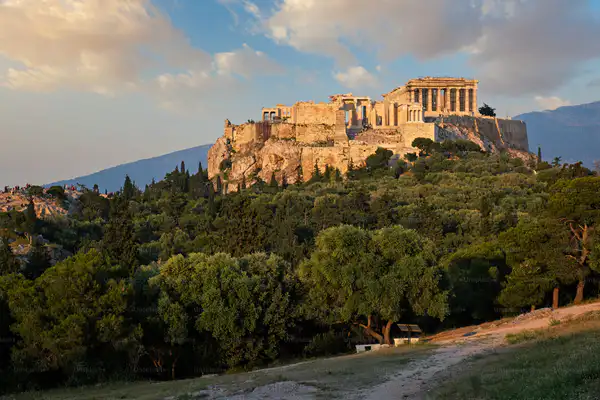
When Pericles proposed his building program for the Acropolis in 449 BCE, he faced fierce opposition. The money he intended to use came from the treasury of the Delian League — contributions from Athens' allies, ostensibly for defense against Persia. Now Pericles wanted to use this tribute to build temples.
His opponents were outraged. "The allies' money," they argued, "is being used to gild and beautify our city as if she were a vain woman, decking herself out with precious stones and costly temples." Athens was acting like a tyrant, they said, spending others' money on her own glory.
Pericles' response was audacious. Athens, he argued, had fulfilled its obligation: the Persians had been defeated, the seas were safe. The allies contributed for protection, and protection they had received. If there was surplus, Athens could use it as she saw fit.
But then Pericles made an offer that silenced his critics: if the Athenians did not want to use public funds, he would pay for the entire building program himself — and dedicate the buildings in his own name rather than the city's.
The Assembly was horrified. The Parthenon, named for Pericles? Never. They voted to continue public funding.
For the next twenty years, under Pericles' leadership, the Acropolis was transformed. He appointed Phidias, the greatest sculptor of the age, as artistic director. He commissioned architects Ictinus and Callicrates to design the Parthenon, Mnesicles to design the Propylaea, Callicrates again for the Temple of Athena Nike. Thousands of workers — citizens, metics (resident aliens), and slaves — were employed in quarrying, transporting, carving, and assembling the marble.
Pericles did not live to see the project completed. He died of plague in 429 BCE, during the Peloponnesian War that would eventually bring Athens to its knees. But his buildings survived — through Roman occupation, Byzantine conversion, Ottoman mosques, Venetian bombardment, and modern restoration. When we speak of the "Age of Pericles," we mean those few decades when democracy, art, philosophy, and architecture achieved a perfection never since equaled.
His Funeral Oration, delivered after the first year of the war, explained what he had tried to build: "We are lovers of beauty without extravagance, and lovers of wisdom without weakness... Future ages will wonder at us, as the present age wonders at us now." He was right.