
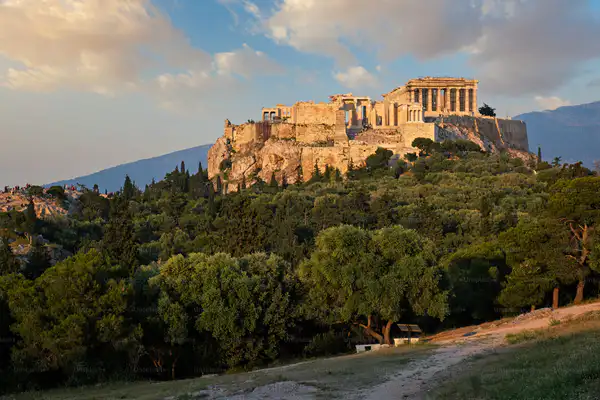
In the autumn of 480 BCE, the most powerful man alive stood on the hilltop at the center of Athens and watched it burn. King Xerxes of Persia had brought the largest army the ancient world had ever seen — maybe 300,000 soldiers — sweeping through Greece. The Spartans had tried to stop him at Thermopylae, a narrow mountain pass, and fought to the last man. It only slowed him down. Athens lay empty. The Athenians had already fled, betting everything on their navy.
But not everyone left. A handful of priests and fighters barricaded themselves on top of the Acropolis — Athens' sacred hilltop — hiding behind wooden walls. They believed the Oracle's famous prophecy about "wooden walls" saving Athens was about them. It wasn't. Persian soldiers found a hidden path up the cliff, climbed behind the defenders, and killed every last one of them — right at the altars where they'd gone to pray. Then they set everything on fire.
Centuries of sacred history went up in flames that day. The grand old Temple of Athena — covered in painted carvings and filled with offerings — collapsed into rubble. Priests had managed to carry away the most sacred object in Athens, an ancient olive-wood statue of the goddess. But everything else — every treasure, every painted column, every piece of art that generations had given to their gods — was gone. Xerxes had ripped the soul out of Athens.
Xerxes barely had time to celebrate. An Athenian general named Themistocles — one of the sharpest military minds in history — tricked the massive Persian fleet into sailing into the narrow waters near the island of Salamis. It was a trap. The huge Persian warships couldn't turn around. The smaller, faster Greek ships tore them apart. Xerxes watched the whole disaster from a throne on the shore, then fled back to Persia. The army he left behind was crushed the following year.
And then came the oath. The Greeks swore they would not rebuild. They would leave every burned temple, every shattered column, every pile of rubble exactly where it fell — as a permanent reminder of what Persia had done. And they meant it. For thirty years, the ruins sat on that hilltop, untouched. An entire generation of Athenians grew up walking past the wreckage of their own holy places.
Then in 449 BCE, Athens signed a peace treaty with Persia, and a leader named Pericles made his case: the oath had been kept long enough. Time to build something the world had never seen. The Parthenon rose from the exact spot where the old temple had burned. Every sculpture on it told the same story — order defeating chaos, civilization beating destruction. It was Athens saying, "You burned us down. Look what we built instead."
Here's the part that gives you chills. When archaeologists dug into the Acropolis in the 1800s, they found the rubble from Xerxes' fire exactly where the ancient Athenians had buried it — scorched statues, shattered carvings, blackened stone. Twenty-five hundred years later, the evidence of the worst day in Athens' history was still there, preserved on purpose. As if the city itself wanted to make sure no one ever forgot.