
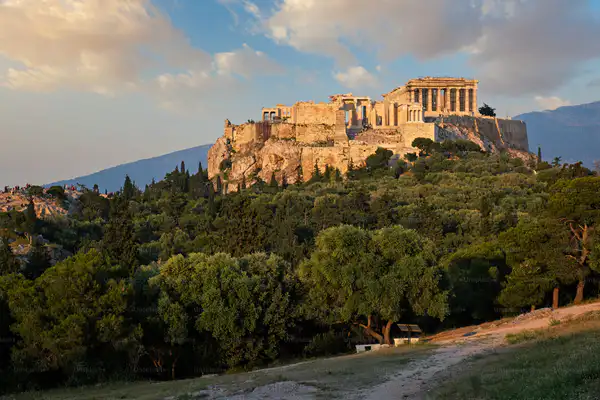
For over two thousand years, the Parthenon had survived everything history threw at it. Earthquakes. Fires. Armies from half a dozen empires. It went from Greek temple to Christian church to Ottoman mosque — battered, repurposed, stripped of its original statues and paint, but still standing. Its bones were intact. Then, on the evening of September 26, 1687, one bomb changed all of that forever.
Here’s the setup. Venice and the Ottoman Empire were locked in a war over the eastern Mediterranean — two superpowers fighting for islands, ports, and trade routes. A Venetian fleet under General Francesco Morosini sailed to Greece and laid siege to Athens. The Ottoman garrison, badly outnumbered, fell back to the Acropolis — the ancient hilltop fortress that was still the strongest defensive position in the city.
Then the Ottoman commander made the decision that would haunt history. He moved his entire gunpowder supply — barrels and barrels of it — inside the Parthenon. His logic wasn’t crazy: for centuries, attacking armies had respected the building because it had served as a Christian church. He was gambling that the Venetians, fellow Christians, would never shell it. It was a reasonable bet. It was also dead wrong.
A Swedish officer named Count von Königsmark, serving with the Venetian forces, aimed his cannons straight at the hilltop. For three days starting September 23rd, cannonballs slammed into ancient walls and temples. Then, around seven in the evening on September 26th, a mortar shell arced over the fortifications, punched through the Parthenon’s roof, and landed directly on top of the gunpowder.
The explosion killed three hundred people instantly — soldiers, women, children who had taken shelter inside. The center of the building was blown wide open. Eight columns on the south side gone, six on the north gone, the entire inner chamber destroyed. Sculptures carved during the golden age of Athens — we’re talking the 400s BC, the era of Pericles — were shattered or hurled hundreds of meters. Marble blocks weighing tons scattered across the hilltop like dice thrown by a giant.
And then came the insult on top of the injury. Morosini marched into the wreckage and decided to take a trophy — the massive stone horses that decorated the roofline. His workers rigged up ropes to lower them. The ropes snapped. The horses crashed to the ground and shattered into pieces. The Venetians held Athens for less than a year before abandoning the city. Their grand prize: a ruin they created and couldn’t even loot properly.
Next time you see a photo of the Parthenon — that famous silhouette, the row of columns, the gaps where the roof used to be — know that you’re looking at the scar from one night. Every empty space where a sculpture once stood, every broken column, every stretch of wall that just stops mid-air — that’s September 26, 1687. War destroyed in one evening what twenty-one centuries of time could not.