
About
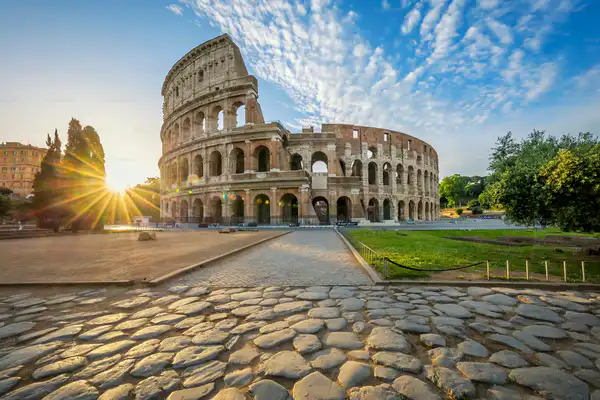
The Colosseum, known formally as the Flavian Amphitheatre, is the largest amphitheatre ever built and one of the most recognizable monuments of the ancient world. Standing at the heart of Rome, this colossal elliptical arena was constructed between 72 and 80 AD under the Flavian emperors Vespasian and Titus, rising from the drained basin of Emperor Nero's private artificial lake as a deliberate gift to the Roman people. Its construction was both a political masterstroke and an engineering marvel, designed to hold between 50,000 and 80,000 spectators who came to witness gladiatorial combat, wild beast hunts known as venationes, public executions, mock sea battles, and dramatic re-enactments of famous victories. The amphitheatre measures 189 meters in length, 156 meters in width, and originally stood 48.5 meters tall across four stories of arched travertine limestone, tuff, and brick-faced concrete. Its exterior facade presented 80 arched entrances at ground level, allowing the entire audience to be seated within minutes through an ingenious system of corridors and stairways called vomitoria. The arena floor, measuring 87 by 55 meters, was covered in sand — the Latin word for which, harena, gave us the English word "arena." Beneath this floor lay the hypogeum, an elaborate underground network of tunnels, cages, and mechanical lifts that could raise scenery, animals, and fighters directly into the arena through trap doors, creating spectacular surprise appearances that thrilled the crowd. Perhaps the most astonishing feature was the velarium, an enormous retractable canvas awning that could be stretched across the top of the amphitheatre to shade spectators from the Mediterranean sun. This feat required a detachment of sailors from the Roman imperial fleet stationed permanently nearby, who operated the complex rigging system using the same skills they employed on warships. The Colosseum's sophisticated engineering — from its concrete foundations to its drainage systems, from its tiered social seating to its underground staging areas — represented the absolute pinnacle of Roman architectural and engineering achievement. After centuries of use, the Colosseum suffered damage from earthquakes, stone-robbers, and neglect. Yet even in ruin, it remains the most iconic symbol of Imperial Rome and one of the most visited monuments on Earth. In 1990, UNESCO designated the historic centre of Rome, including the Colosseum, as a World Heritage Site. In 2007, it was named one of the New Seven Wonders of the World. Today it stands as a testament to both the grandeur and the brutality of the civilization that built it — a place where architectural genius served spectacles of astonishing violence, and where the roar of tens of thousands once echoed across the Eternal City.
Historical Significance
“The Colosseum represents the definitive architectural achievement of the Roman Empire and the most enduring symbol of its power, engineering genius, and cultural values. Built by the Flavian dynasty on the site of Nero's despised private pleasure gardens, the amphitheatre was a calculated act of political legitimacy — returning to the people what Nero had selfishly claimed for himself. The message was unmistakable: where a tyrant had indulged in private luxury, the new dynasty would provide public spectacle and civic pride. The inaugural games of 80 AD, hosted by Emperor Titus, lasted 100 days and were among the most lavish spectacles in Roman history. Ancient sources record that 9,000 wild animals were killed during these games alone. The amphitheatre became the primary venue for munera (gladiatorial combats), venationes (wild beast hunts), and occasionally naumachiae (mock naval battles in a flooded arena). At its peak, these spectacles were essential to the political contract between emperor and people — the "bread and circuses" that Juvenal famously identified as the twin pillars of Roman social control. The Colosseum's influence on architecture has been immeasurable. Its elliptical design, tiered seating, numbered entrances, and crowd-management systems are the direct ancestors of every modern stadium and arena. The basic principles pioneered here — efficient ingress and egress, sightline optimization, social stratification of seating — remain the foundation of sports venue design two thousand years later. When the Colosseum was inscribed as part of Rome's UNESCO World Heritage Site in 1990 and voted one of the New Seven Wonders of the World in 2007, it was recognized not merely as a ruin but as one of the most influential buildings in human history.”
Stories
3History
👑 Built by
Emperor Vespasian (begun 72 AD), Emperor Titus (completed and inaugurated 80 AD), Emperor Domitian (final modifications)
72 AD - Emperor Vespasian orders construction to begin on the site of Nero's artificial lake
79 AD - Vespasian dies; his son Titus oversees completion of the upper levels
80 AD - Grand inauguration by Titus with 100 days of games; 9,000 animals killed
81-96 AD - Emperor Domitian adds the hypogeum underground complex and upper gallery
217 AD - Major fire damages the upper wooden levels; repairs take until 240 AD
404 AD - Last recorded gladiatorial combat, after Emperor Honorius bans the practice
443 AD - Major earthquake causes significant structural damage
523 AD - Last recorded animal hunts (venationes) held in the arena
1349 - Devastating earthquake collapses the entire outer south wall
1749 - Pope Benedict XIV consecrates the Colosseum as a sacred site of Christian martyrdom
1990 - UNESCO World Heritage Site inscription (Historic Centre of Rome)
2007 - Named one of the New Seven Wonders of the World
2023 - Completion of major restoration of the hypogeum, opened to the public