
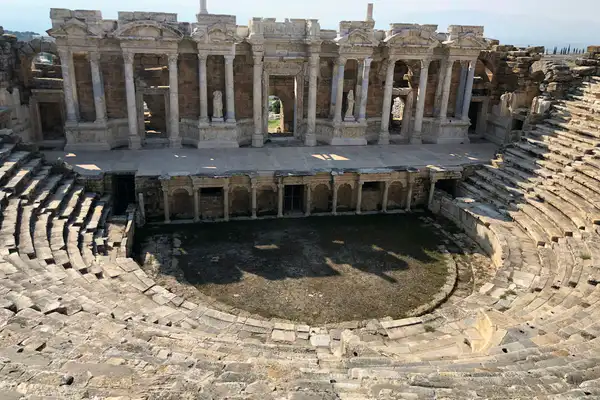
It's 334 BC. Alexander the Great, the young king of Macedonia, has just crossed the Hellespont — the narrow strait between Europe and Asia — with a massive army. His goal: to crush the Persian Empire. One of the first major cities on his route is Ephesus, one of the most magnificent cities in the ancient world.
Ephesus had been suffering under Persian control for years. Oligarchs installed by the Persians ruled the city with an iron fist. When Alexander arrived and drove them out, the city erupted in celebration. The Ephesians didn't see another conqueror — they saw a liberator.
But here's where the story gets fascinating. Ephesus was home to the Temple of Artemis — one of the Seven Wonders of the World. Years earlier, a man named Herostratus had burned it down for no reason other than to make himself famous. And the detail that sends a chill down your spine: the fire happened the very night Alexander was born.
The temple was still being rebuilt when Alexander arrived. He recognized the poetic symmetry immediately and made a staggering offer: he would personally fund the entire reconstruction — the most expensive building project in the Greek world. His only condition? His name inscribed on the dedication.
The Ephesians were trapped. Refusing the most powerful man on Earth could mean death. But carving a mortal's name on a goddess's temple was sacrilege. Saying yes was unthinkable. Saying no was suicidal.
They say the pen is mightier than the sword. The Ephesians proved that the right words are mightier still. They told Alexander: "It is not fitting for one god to build a temple to another god." Read that again. They didn't say no. They told him he was too divine for the honor.
The flattery was so flawless that Alexander — who genuinely believed he was the son of Zeus — accepted the refusal with a smile instead of a sword. The Ephesians completed the temple with their own money, and it stood as a Wonder of the World for another six centuries.
They said no to the most powerful man on the planet. And they survived. How? By telling him he was too great for the favor he was offering. That is diplomacy at its absolute finest.