
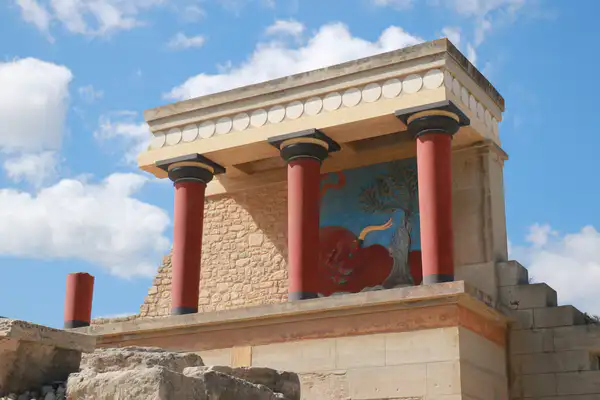
Picture this: a bull the size of a small car, charging full speed. Right in front of it, a teenager — arms out, waiting. Not to dodge. Not to run. To grab those horns and flip over the animal's back like a gymnast sticking a landing. Men and women both. That's what the Minoans painted on the walls of Knossos, their massive Bronze Age palace on Crete, over 3,500 years ago. The famous Bull-Leaping Fresco shows the whole act frozen in time: the grab, the mid-air somersault, the perfect landing.
Here's how it actually worked. The leaper ran straight at a charging bull, grabbed its horns, and used the animal's natural head-toss like a springboard — launching into a handspring or somersault clean over its back. Teammates waited behind the bull, ready to catch the leaper or pull the animal's attention if things went wrong. The whole thing took seconds. There was zero room for mistakes. You either nailed it, or the bull nailed you.
These weren't regular farm animals. The bulls in Minoan art look like the wild ancestors of modern cattle — massive beasts topping a thousand pounds, with horns that could end you in a heartbeat. Modern athletes have tried to recreate bull-leaping. They've mostly failed. The animals are too fast, too unpredictable, too strong. The Minoans who pulled this off must have trained from childhood, building reflexes beyond normal human limits. Not all of them made it.
But here's what's fascinating: the frescoes don't show fear. The leapers look graceful, almost joyful. And unlike Spanish bullfighting, where the whole point is to dominate and kill the animal, Minoan bull-leaping was something completely different. They weren't fighting the bull — they were dancing with it. Every image shows the animal as a magnificent, powerful partner, not an enemy. It wasn't about conquest. It was about respect.
Nobody knows exactly why they did it. Some historians think it was a fertility ritual — the bull represented raw natural power, and the leap proved humans could work with that power without destroying it. Others believe it was a coming-of-age test, the ultimate trial to prove you were ready for adulthood. Still others connect it to an ancient bull god worshipped across the Mediterranean. Whatever the reason, bull-leaping sat at the heart of Minoan culture for centuries.
When British archaeologist Arthur Evans dug up the Bull-Leaping Fresco in the early 1900s, he knew right away this wasn't fantasy — it showed a real practice. He published his findings in a work called The Palace of Minos, and the world couldn't stop debating it. Was this physically possible? Scholars argued for decades. But similar feats exist today — in parts of East Africa and Spain, people still vault over live cattle. The Minoans just did it with the highest possible stakes.
Here's the part that'll keep you up at night. Some researchers think bull-leaping is the real story behind the Minotaur — the half-bull, half-man monster from the maze beneath Knossos. The myth says Athens sent its young to Crete as sacrifices. But what if they weren't fed to a monster — but trained as bull-leapers, with those who failed dying in the arena? The "Labyrinth" might be the palace itself. Theseus "slaying the Minotaur" could be the memory of one athlete who finally beat the bull.