
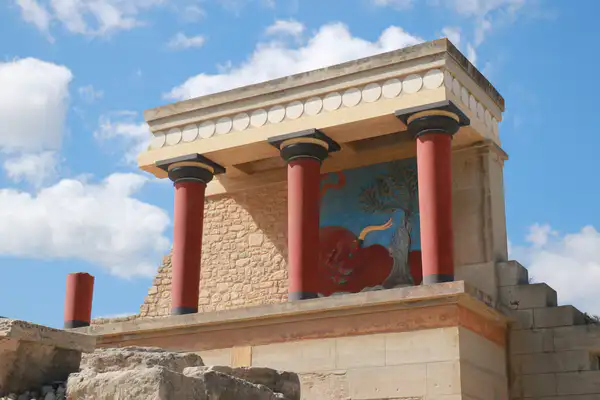
Daedalus was the greatest craftsman the world had ever known. An Athenian by birth, he had fled to Crete after murdering his nephew Perdix, whose talent threatened to surpass his own. At the court of King Minos, Daedalus found patronage and purpose. He built marvels: the wooden cow for Pasiphae, the Labyrinth to contain the Minotaur, dancing floors for the princess Ariadne, and countless other wonders that made Knossos the envy of the ancient world.
But Daedalus knew too many of the royal family's secrets. He had built the device that led to the Minotaur's conception. He had designed the Labyrinth and knew its solution. When Ariadne helped Theseus escape using Daedalus's own knowledge of the maze, Minos's fury turned on the craftsman. The king imprisoned Daedalus and his young son Icarus in a high tower overlooking the sea. Every port was watched, every road guarded. Minos controlled the land and the sea, and Daedalus knew that no ship would carry them to freedom.
But as Daedalus watched the gulls and eagles that circled the tower, inspiration struck. "Minos may rule the earth and the waves," he told Icarus, "but he does not own the sky." He began to collect feathers — from the seabirds that roosted on the tower, from his bedding, from any source he could find. With meticulous care, he arranged them in rows from smallest to largest, bending them into gentle curves, binding the larger feathers with thread and the smaller ones with wax. Slowly, two pairs of wings took shape, each one a masterwork of engineering and desperation.
When the wings were complete, Daedalus fitted the smaller pair onto Icarus's shoulders and gave his son the warning that would become the most famous caution in all of mythology: "Fly the middle course, my son. If you fly too low, the sea spray will soak the feathers and drag you down into the waves. If you fly too high, the heat of the sun will melt the wax that holds the feathers together. Stay close to me. Follow my path, and we will reach freedom."
They leapt from the tower into the open air and flew. The sensation was miraculous — the wind rushing past, the earth falling away beneath them, the sea glittering far below like hammered bronze. Fishermen in their boats looked up in astonishment, believing they were seeing gods. Shepherds on the hillsides dropped their staffs and stared at the two figures soaring through the heavens.
But Icarus was young, and the joy of flight was intoxicating beyond anything his father had warned him about. He began to climb higher, drunk on the miracle of soaring, wanting to touch the very face of the sun. Daedalus called out to him, but the wind snatched his words away. Higher and higher Icarus flew, and as he rose, the sun's heat began to soften the wax. Feathers loosened and fluttered away behind him like a trail of falling stars. By the time Icarus felt himself faltering, it was too late. His wings disintegrated, and with a scream that his father would hear in his nightmares forever after, the boy plummeted into the sea.
Daedalus circled the spot where Icarus had fallen, crying his son's name again and again, but there was nothing to be done. He gathered the boy's body from the water and buried him on a nearby island, which he named Icaria in his memory. The sea itself was called the Icarian Sea. Then, alone and broken, the greatest craftsman in the world flew on to Sicily, where he lived out his remaining days in exile. He never built wings again.