
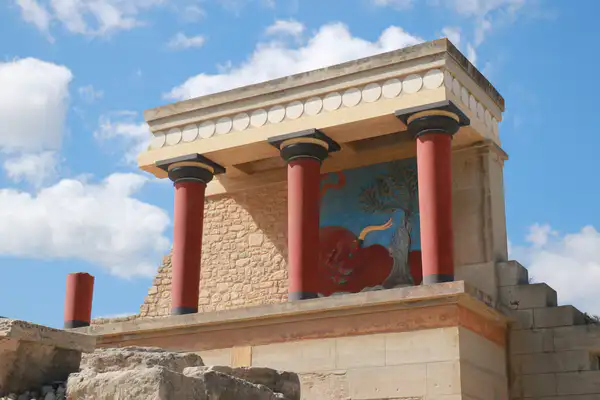
Long before the palace of Knossos was built, long before the Labyrinth and the Minotaur, the story of Crete began with a Phoenician princess named Europa. She was the daughter of King Agenor of Tyre, renowned across the ancient world for her extraordinary beauty — a beauty that caught the attention of Zeus himself, king of the gods on distant Olympus. Zeus, who had taken mortal lovers before, became consumed with desire for Europa, but he knew that approaching her in his divine form would terrify her. So the lord of thunder and lightning chose a different disguise.
Zeus transformed himself into a bull — but not an ordinary bull. He became the most beautiful creature ever to walk the earth: pure white, with flanks that gleamed like polished marble, horns that curved like crescent moons and shone as if carved from jewels, eyes that were deep and gentle. This miraculous animal wandered down to the beach near Sidon where Europa and her handmaidens were gathering flowers by the shore.
The girls noticed the extraordinary bull and were enchanted. It seemed completely tame, breathing fragrant saffron from its mouth, lying down peacefully in the meadow grass. Europa, emboldened by its gentleness, approached and stroked its gleaming flank. The bull licked her hand with a warm tongue. Laughing, she wove garlands of flowers around its horns. It bowed its great head in seeming submission. Growing bolder still, Europa climbed onto its broad white back.
The moment she was seated, everything changed. The bull rose and walked calmly toward the sea. Before Europa could dismount, it was wading into the waves. Before she could scream, it was swimming — swimming with impossible power and speed, cutting through the Mediterranean like a ship under full sail. Europa could only cling to its great curved horns as the shore of her homeland shrank and vanished behind her. Sea nymphs rose from the waves to escort them. Poseidon himself calmed the waters. Dolphins leaped alongside as if celebrating a divine procession.
After crossing the breadth of the sea, the bull came ashore on the island of Crete, at a place called Gortyn. There, beneath a great plane tree whose descendants still stand, Zeus revealed his true identity to Europa. He shed his animal form and appeared in all his divine radiance. Europa, overwhelmed by the revelation that her abductor was the king of the gods himself, became his lover.
She bore Zeus three sons who would shape the history of the ancient world. The eldest was Minos, who would become the legendary king of Crete, builder of the great palace at Knossos, and ruler of the most powerful maritime empire the Aegean had ever known. The second was Rhadamanthys, famed for his justice, who after death would serve as one of the judges in the underworld. The third was Sarpedon, who would found a dynasty in Lycia, in Asia Minor.
Zeus could not take Europa as his wife — he was already married to the jealous Hera — but he honored her with three extraordinary gifts: Talos, a giant bronze automaton who would patrol the coasts of Crete and protect it from invaders; Laelaps, a hunting hound that never failed to catch its prey; and a javelin that never missed its mark. He then gave Europa in marriage to Asterion, a Cretan king who adopted her divine sons as his own. Thus the royal line of Crete was established by a god's desire and a princess's courage, and the continent of Europe itself would one day bear her name.