
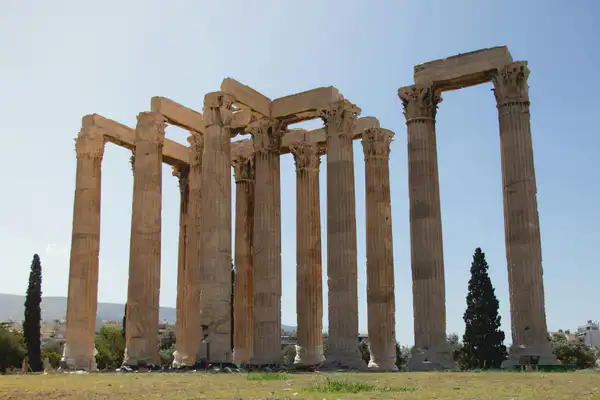
In the ninth century BCE, the Peloponnese was ravaged by plague and endless warfare. City fought city, tribe fought tribe, and the people of Greece seemed bent on destroying themselves. King Iphitos of Elis, desperate for divine guidance, journeyed to the Oracle at Delphi to ask the Pythia how the suffering might be ended. The Oracle's answer was unexpected: Iphitos must restore the athletic games at Olympia and establish a sacred truce during which all warfare would cease.
Iphitos sought allies for this audacious plan. He found them in Cleosthenes of Pisa, who controlled the territory around Olympia, and Lycurgus of Sparta, the legendary lawgiver whose word carried weight across the entire Greek world. Together, these three leaders forged an agreement known as the Ekecheiria — the Sacred Truce. The terms were inscribed on a bronze discus that was kept in the Temple of Hera at Olympia and shown to visitors for centuries. Pausanias himself saw and described it.
The Ekecheiria declared that for the duration of the Olympic festival — initially one month, later extended to three — all Greek states must cease all hostilities. No army could march, no city could be besieged, no execution could be carried out. The territory of Elis, the host state, was declared permanently sacred and inviolable; no armed force could enter it at any time. Athletes, spectators, and pilgrims were guaranteed safe passage through any territory on their way to and from Olympia, even through lands belonging to their enemies.
To announce each truce, three sacred heralds called spondophoroi were dispatched from Elis to every corner of the Greek world. These heralds, crowned with olive wreaths and carrying staffs of office, traveled to every Greek city-state — from the colonies of Sicily and southern Italy to the shores of the Black Sea, from the cities of North Africa to the islands of the Aegean. Their persons were sacrosanct; to harm a spondophoros was to offend Zeus himself. Upon their arrival, they proclaimed the dates of the games and invoked the truce. Wars were suspended, armies withdrew, and the roads to Olympia became safe for all travelers.
The most remarkable aspect of the Ekecheiria was that it was respected almost universally for over a thousand years. In a world where treaties were routinely broken and alliances constantly shifted, the Sacred Truce held. Its power came not from military enforcement but from religious conviction: the Olympics were sacred to Zeus, and to violate the truce was to invite divine punishment.
The most famous violation occurred in 420 BCE, during the Peloponnesian War. Sparta sent armed forces through Elean territory and attacked the fortress of Lepreum during the truce period. The Eleans demanded a fine of two thousand minas — two minas for each soldier involved. Sparta refused to pay, and the Spartans were banned from the Olympic Games of that year. The Spartans, the most formidable warriors in Greece, complied with their exclusion rather than attack the sanctuary. Even Sparta would not desecrate Olympia.
The truce endured for 1,169 years, from the traditional founding of the games in 776 BCE until Emperor Theodosius I banned them in 393 CE. In all that time, the concept of sacred peace through athletic competition was violated only a handful of times. The Ekecheiria proved that even the most warlike peoples could find reasons to lay down their arms, that shared religious values could transcend political conflict, and that the desire for honorable competition could, however briefly, silence the drums of war.