
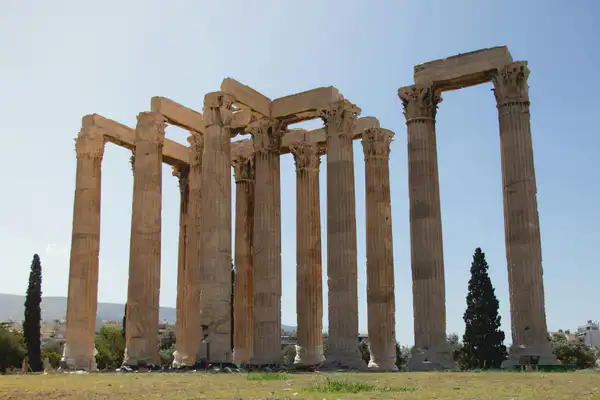
Around 435 BCE, the people of Elis summoned the greatest sculptor in the Greek world to Olympia. Phidias of Athens had already created the colossal bronze Athena Promachos on the Acropolis and the gold-and-ivory Athena Parthenos inside the Parthenon. Now he was tasked with an even greater commission: a statue of Zeus for the god's own temple at Olympia, the most sacred sanctuary in Greece. What Phidias created would become one of the Seven Wonders of the Ancient World and the most revered religious image in antiquity.
The statue was chryselephantine — constructed of gold and ivory over a wooden framework. Zeus sat enthroned, his flesh rendered in polished ivory that seemed to glow with divine life, his robes and sandals wrought in hammered gold that caught and reflected the temple's dim interior light. In his right hand, the god held a small figure of Nike, the winged goddess of Victory, herself made of gold and ivory. In his left hand, he grasped a scepter of precious metals, topped with an eagle — the sacred bird of Zeus. His throne was decorated with gold, ebony, ivory, and precious stones, carved with scenes of gods, heroes, and mythological battles.
The statue rose nearly forty feet from the temple floor. Strabo recorded the famous observation that if Zeus had stood up from his throne, he would have burst through the roof of the temple. This was not a criticism of Phidias's proportions but a testament to the overwhelming presence the sculptor had achieved. The god was not merely represented — he was made manifest. The statue filled the temple's cella with a divine presence so powerful that visitors reported feeling they were in the actual presence of the king of the gods.
Ancient writers competed to describe the statue's effect on those who saw it. Pausanias wrote that the statue was so beautiful that it added something even to the majesty of Zeus himself. Dio Chrysostom, the orator, declared that any person who stood before the statue would forget every sorrow and hardship they had ever endured, so powerful was the sense of peace and divine benevolence that radiated from the golden face. He said that anyone who had lived their entire life without seeing the statue of Zeus at Olympia had not truly lived, for they had missed the most sublime sight mortal eyes could behold.
Visitors wept openly upon entering the temple. Grown men, hardened soldiers, and seasoned travelers broke down before the serene gaze of the enthroned god. The ivory skin seemed warm and alive. The gold drapery appeared to ripple in an unfelt breeze. The eyes, set with precious stones, followed the viewer with a gentle omniscience that conveyed both infinite power and infinite mercy.
According to tradition, when Phidias completed the statue, he prayed to Zeus for a sign that the god approved of his image. Immediately, a thunderbolt struck the marble floor of the temple, leaving a black mark that was pointed out to visitors for centuries afterward. The god had given his approval.
The statue presided over the Olympics for nearly nine centuries. But in the late fourth century CE, as Christianity spread across the Roman Empire, the statue's fate grew uncertain. Some time in the late fourth or early fifth century, the statue was transported to Constantinople, the new Christian capital. There, in a palace, the chryselephantine Zeus was destroyed by a great fire in 475 CE. The gold melted, the ivory cracked and burned, the wooden framework was consumed. One of the Seven Wonders of the Ancient World vanished forever, surviving only in the words of those who had wept before it.