
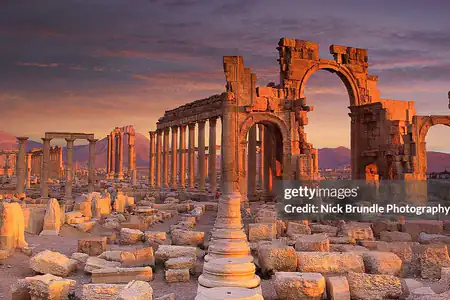
Two hundred kilometers from the nearest coast, in the Syrian desert, a warm spring bubbled up through the rock. Date palms grew around it. Then an oasis. Then, against all logic, one of the richest cities the ancient world ever saw. The Arabs called it Tadmor — “city of date palms.” The Greeks named it Palmyra. The Bible says King Solomon built it. He almost certainly didn’t — but the place was so wealthy that only the wisest king in history seemed like a believable founder.
What actually built Palmyra was simpler: location and nerve. It sat exactly halfway between Rome and Persia — two superpowers that needed to trade but couldn’t stand each other. The alternatives were mountain passes far north or brutal desert to the south. Palmyra was the only oasis big enough to keep a caravan alive on the direct route. Its merchants became the ultimate middlemen — belonging to neither empire, serving both, getting rich off everyone.
The goods flowing through were staggering. Silk from China. Pepper and cinnamon from India. Frankincense from Arabia. Pearls from the Persian Gulf. Ivory from Africa. Roman wine and glass headed east in return. Palmyra didn’t make any of it — the city just moved it, taxed it, and skimmed a fortune off every deal. Its merchant families were the world’s first global logistics operators, running a trade empire without ever raising an army.
The caravan leaders were part financier, part soldier, part CEO. They funded hundreds of camels, hired private armies, and crossed weeks of open desert where one wrong turn meant death. When one brought the cargo home safe, the city gave him its highest honor: a bronze statue on the main street. That avenue stretched over a kilometer, lined with 750 columns, each carrying a merchant’s likeness. In Rome, you got a statue for winning a war. In Palmyra, you got one for delivering the silk.
In 137 AD, the merchants got tired of corrupt tax collectors making up rates. So they carved the entire tax code onto a five-meter limestone slab — in both Aramaic and Greek — and planted it in the public square. Every product, every rate, visible and permanent. It was transparency literally set in stone. That slab still exists today, in the Hermitage Museum in Saint Petersburg — one of the longest ancient inscriptions ever found.
At its peak in the 200s AD, a hundred thousand people called this place home. Golden sandstone caught the desert light. The Temple of Bel ranked among the greatest in the Middle East. Outside the walls, tower tombs rose five stories, packed with the dead, their portraits showing women draped in pearls and gold. Everything here was translation — goods between empires, inscriptions in two languages, gods borrowed from a dozen cultures and blended into something new.
Then in 272 AD, a Palmyrene queen named Zenobia made a fatal bet. She decided her city shouldn’t just be a middleman — it should be an empire. She conquered Egypt, seized chunks of Roman territory, and declared independence. The Roman Emperor Aurelian marched east with his legions and crushed her. The city that had thrived for centuries by belonging to no one was destroyed the moment it tried to become someone.
Some of those columns still stand in the Syrian desert, their brackets empty, the bronze merchants long gone. But the tax stone endures in its glass case in Saint Petersburg. And if you read its rows of numbers and goods, you can still hear the heartbeat of a city that believed the truest power wasn’t an army — it was standing between two worlds and being the only one who could speak to both.