
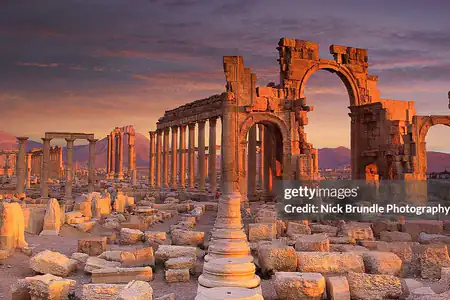
Khaled al-Asaad spent fifty years walking the same ruins every single day. Born in 1932 in Tadmor — the Syrian town beside ancient Palmyra — he grew up treating colonnades like a backyard. He studied history in Damascus, came home, and in 1963 became director of antiquities at Palmyra. Forty years. When he retired in 2003, nothing changed — he showed up every morning. He named his daughter Zenobia, after Palmyra’s warrior queen. The ruins weren’t his workplace. They were him.
Every international team that dug at Palmyra — Polish, German, French, Japanese, American — worked through him. He ran excavations at the Temple of Bel and the Valley of the Tombs. He translated thousands of Palmyrene Aramaic inscriptions, the key to the city’s past. Known as ‘Mr. Palmyra,’ he’d walk anyone through the ruins — professor or tourist — sharing stories from fifty years of devotion. He wasn’t studying history. He was the living bridge to it.
In spring 2015, ISIS was closing in. They’d already smashed artifacts in Iraq’s Mosul Museum on camera and bulldozed ancient Assyrian cities. Everyone knew what Palmyra’s capture would mean. Al-Asaad and Syria’s antiquities chief Maamoun Abdulkarim organized a desperate rescue, loading hundreds of artifacts — statues, reliefs, funeral portraits — onto trucks for Damascus. When time ran out, al-Asaad made the calls. He knew every piece.
Palmyra fell on May 20, 2015. The town emptied. Colleagues begged him to leave — he was eighty-three, he’d done everything he could, his children were waiting. He refused. He’d spent his whole adult life here. ISIS captured him almost immediately. For a month, they interrogated and tortured him. They wanted two things: gold they believed lay under the ruins, and the location of the evacuated artifacts. He gave them nothing. Not a word.
On August 18, 2015, ISIS publicly beheaded Khaled al-Asaad in his hometown. They hung his body from a post, glasses still on — a scholar’s mark turned into a taunt. A sign around his neck listed his ‘crimes’: attending international conferences, working with foreign governments, being the ‘director of idolatry.’ Every artifact preserved, every inscription translated, every foreign colleague welcomed — his life’s work was the evidence against him. He was eighty-three.
Then ISIS did exactly what everyone feared. They dynamited the Temple of Baalshamin. They blew up the Temple of Bel — a building from 32 AD that had survived two thousand years of wars, empires, and changing religions. They destroyed the Monumental Arch. They toppled tower tombs. They smashed the Lion of Al-lat statue. They used the Roman theater for mass executions. They were trying to erase Palmyra from the record.
When Syrian forces recaptured Palmyra in March 2016, the Great Colonnade and Roman theater still stood. In Damascus, every artifact al-Asaad had saved — funeral busts, inscriptions, carved faces from two thousand years ago — sat where he’d sent them. Safe. The Polish team that worked beside him for decades came back and rebuilt the shattered Lion of Al-lat from its fragments. A Russian orchestra played in the battered theater. The stones remembered.
Here’s what stays with me. ISIS had guns, explosives, and absolute power over one captive old man. They had a month to break him. And an eighty-three-year-old archaeologist with glasses — who’d never held a weapon in his life — beat them. The artifacts are still safe. The treasures they demanded were never found. He didn’t just protect ruins. He proved that the people who remember are harder to destroy than the things they remember.