
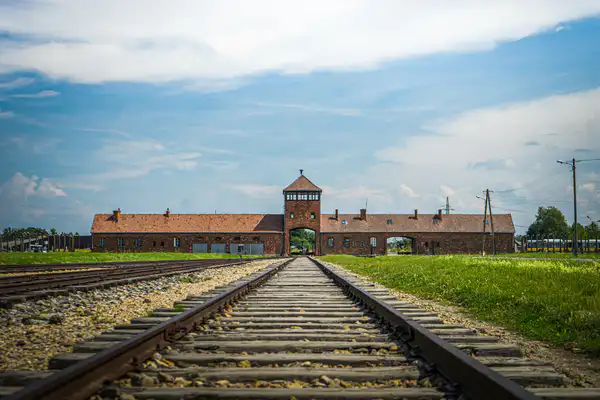
In the summer of 1941, Auschwitz was not yet the industrialized death factory the world would come to know. It was a concentration camp for Polish political prisoners, and terror was maintained not through mass extermination but through calculated, personal cruelty. When a prisoner escaped in July, the SS commandant Karl Fritzsch decreed a collective punishment: ten men from the escapee's barracks would be selected and locked in the underground bunker of Block 11 — the building prisoners called the "Death Block" — to starve to death.
The selection took place on the roll call square, under a brutal summer sun. The prisoners stood in rows, motionless, while Fritzsch walked among them pointing at men seemingly at random. When his finger landed on Franciszek Gajowniczek — a Polish army sergeant — the man cried out from the depths of his soul: "My wife! My children!" Every prisoner in that square understood the cry in the marrow of their bones, because each of them had someone, somewhere, they might never see again.
Then, from among the silent, terrified ranks, a man stepped forward. He was small, gaunt, bespectacled. On his striped uniform, the number 16670. His name was Maximilian Kolbe. Before the war he had been a Franciscan friar — a priest, a publisher, a missionary who had founded monasteries in Japan and India. The Gestapo arrested him for sheltering Jews and Polish refugees in his monastery at Niepokalanów.
Kolbe approached the commandant and made a request no one had ever made in the history of the camp: to take Gajowniczek's place. "I am a Catholic priest," he said. "I am old. He has a wife and children." He was forty-seven. Fritzsch — perhaps stunned, perhaps amused by the absurdity of a man choosing death voluntarily — accepted the substitution.
Kolbe and the nine other condemned men were locked in the starvation bunker — a windowless underground cell with no food, no water. Death by starvation in these cells typically took two weeks. The guards were used to hearing screaming, weeping, and agonized moaning. From Kolbe's cell, they heard something else: singing.
They say there is no greater love than to lay down one's life for a friend. Kolbe laid down his for a stranger. He led the condemned in hymns and prayers, heard their confessions, offered comfort as they died. Bodies collapsed one by one onto the concrete floor, but his voice — growing weaker, never ceasing — carried on. After two weeks, when the SS needed the cells, four men were still alive. Kolbe was the last conscious one, kneeling against the wall, still praying.
The camp doctor entered with a syringe of carbolic acid. Kolbe, too weak to speak, extended his left arm. He died on August 14, 1941 — the vigil of the Feast of the Assumption of Mary. Believers would later call this coincidence providential.
Franciszek Gajowniczek survived Auschwitz. He lived until 1995, dying at ninety-three. For the remaining fifty-four years of his life, he devoted himself to telling Kolbe's story. In 1982, Pope John Paul II — himself a Pole who had lived through the Nazi occupation — canonized Kolbe as a saint and martyr. Gajowniczek was there in St. Peter's Square, weeping openly.
Today, Cell 18 in Block 11 is a memorial shrine. Visitors stand in the narrow concrete corridor and look into the tiny cell where a man chose death with a calm that even the SS guards could not comprehend. On the floor, flowers and candles. In the silence of that underground bunker, something happened that the entire machinery of Auschwitz was designed to make impossible: a man acted freely, chose love over fear, and proved that the human spirit cannot be extinguished even in the darkest place on earth.