
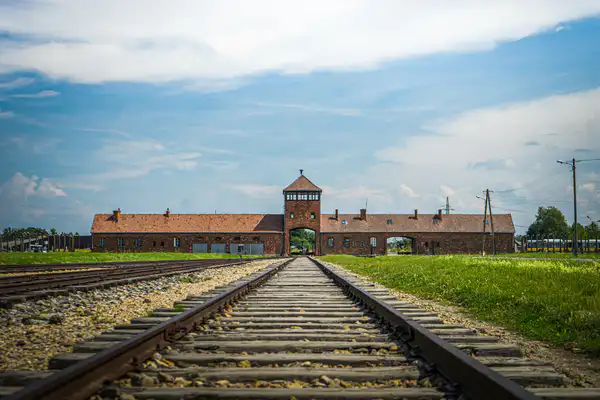
The Sonderkommando were the most doomed people in Auschwitz. Jewish prisoners forced by the Nazi SS to do the unthinkable: guide fellow Jews into gas chambers, carry out the bodies, pull gold teeth from the dead, and feed the remains into ovens. The SS kept them fed and isolated — not out of kindness, but because they needed them strong enough to keep the killing machine running. And every one of them knew the deal. Once they’d seen too much, they’d be killed too.
By autumn 1944, the war was falling apart for Nazi Germany. The Soviet army was closing in from the east, and the SS started tearing down evidence of the genocide — dismantling gas chambers, burning records. The Sonderkommando could read the signs. Their turn was coming. For months, a small group had been quietly building toward something impossible: not an escape plan, not a rescue mission, but a revolt. A final act of defiance by men already marked for death.
The whole plan hung on gunpowder. Four young Jewish women — Ala Gertner, Roza Robota, Regina Safirsztajn, and Estera Wajcblum — worked at a munitions factory next to the camp. For months, they smuggled tiny amounts of gunpowder out, hiding it in the folds of their dresses and in false-bottomed food containers, passing it hand to hand through a chain of prisoners until it reached the crematoria. They were all in their twenties. They knew getting caught meant torture and death. They did it anyway.
On October 7, 1944, word reached the Sonderkommando at Crematorium IV: they were going to be killed that day. So they moved first. With the smuggled gunpowder, homemade grenades built from tin cans, and whatever tools they could grab, they attacked the SS guards. They killed three SS men and set Crematorium IV on fire. Flames and black smoke rose over Birkenau — visible from every corner of the camp.
The prisoners at Crematorium II joined the fight. Some cut through the barbed wire and broke out into the countryside. But the SS brought in reinforcements fast — soldiers, dogs, overwhelming firepower. The runners were hunted down and killed. Within hours, it was over. Four hundred and fifty-one Sonderkommando were dead. Some fell fighting. Most were executed after they surrendered.
The SS traced the gunpowder back to the factory, and then to the four women. Ala, Roza, Regina, and Estera were arrested and tortured for weeks. The SS wanted names — every person in the smuggling chain. Not one of the four women broke. Not one name was given up. Not one other prisoner was put at risk because of what they said.
On January 6, 1945 — just twenty-one days before Soviet troops would liberate Auschwitz — the four women were hanged in front of the assembled prisoners. As the noose was placed around her neck, Roza Robota called out words that survivors would never forget: "Hazak v'amatz" — Hebrew for "Be strong and brave."
They were among the last prisoners executed at Auschwitz. Three weeks later, the camp was free. The crematorium they helped destroy was never rebuilt.