
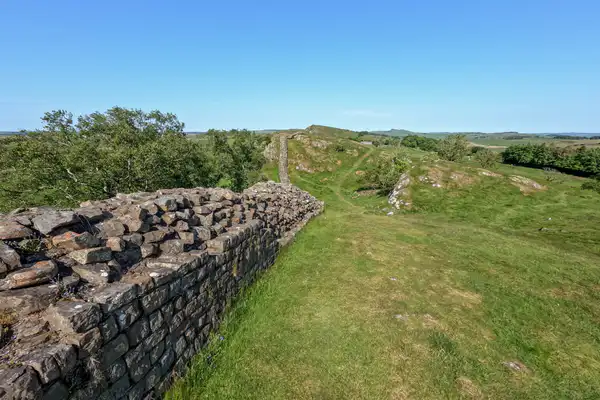
The Ninth Legion — Legio IX Hispana — was no ordinary army unit. These soldiers fought under Julius Caesar during his conquest of Gaul (modern France) in the 50s BC. They followed him into the civil war that destroyed the Republic and gave birth to the Empire. By AD 43, when Emperor Claudius sent them to invade Britain, the Ninth had been fighting for over a century. Five thousand hardened veterans, stationed at York — northern England’s military capital — holding Rome’s most dangerous frontier.
And then they vanished.
The last proof the Ninth existed is an inscription at York, dated AD 108. After that — nothing. No transfer orders, no gravestones, no mention in the obsessively detailed Roman military records. When Emperor Hadrian showed up in Britain in AD 122 to build his Wall, the Ninth was already gone. A new legion was sent from Germany to fill their spot. Rome tracked every unit across three continents. For an entire legion to vanish from the paperwork? Something went very, very wrong.
The most famous theory is the most terrifying. The Ninth marched north into Caledonia — modern Scotland — to crush a rebellion by the Picts, fierce warriors the Romans called “the Painted People.” Imagine five thousand men entering the Highlands: fog-soaked mountains, dense forests, endless bogs — a nightmare for soldiers trained to fight on flat ground. The Picts knew every ridge and river, ambushed the column, cut the supply lines, and destroyed them. Five thousand men swallowed by the mist.
But here’s the twist. In the 1950s, archaeologists found tiles stamped with the Ninth’s mark at a base in Nijmegen, the Netherlands — proof that part of the legion reached mainland Europe after AD 108. Some historians think the Ninth wasn’t destroyed in Scotland at all but transferred and wiped out in a different war entirely — maybe the brutal Jewish revolt in Judaea around AD 132, where Rome lost whole units. One mystery just replaces another. And the silence in the records stays just as loud.
This unsolved disappearance became a British legend. Rosemary Sutcliff turned it into “The Eagle of the Ninth” in 1954 — a novel about a young Roman officer crossing Hadrian’s Wall to find his father’s lost legion. It was required reading for generations of British kids and later inspired the 2011 film “The Eagle.” Sutcliff’s version — the Ninth making a last stand against Pictish warriors in the Highlands — is the story most people carry in their heads, whether they know the source or not.
We may never know what happened. The evidence is just incomplete enough to keep everyone guessing and just complete enough that nobody can look away. But this much is certain: Hadrian built his Wall because something went catastrophically wrong in the north. Whether the Ninth lies under Scottish heather or Middle Eastern sand, their disappearance drew that line across Britain forever. The most powerful empire the ancient world ever produced lost five thousand men — and never found out how.