
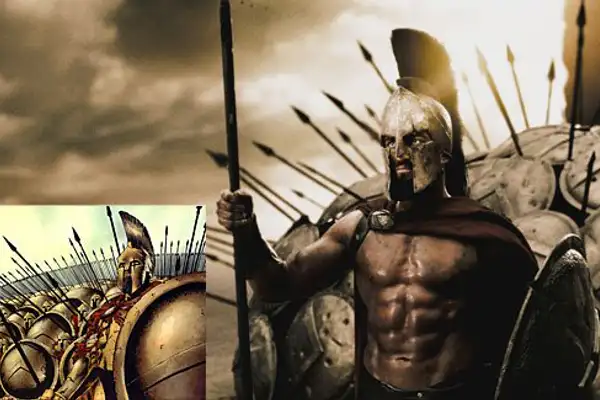
Here's the thing about the Battle of Thermopylae — the most famous last stand in history. It wasn't lost on the battlefield. Three hundred Spartans and a few thousand Greek allies held a narrow coastal pass against the entire Persian Empire, and the Persians couldn't break through. What ended it wasn't a better army. It was one man, a local named Ephialtes, who knew a secret path through the mountains.
For two days in the late summer of 480 BCE, the Greeks made the Persians pay for every inch of that narrow pass. King Xerxes of Persia had brought an army so massive that ancient historians claimed it drank rivers dry. But none of that mattered at Thermopylae. The pass was so narrow that only a handful of men could fight at once — and the Spartans at the front were the best-trained soldiers in the ancient world.
Xerxes was desperate. His elite soldiers, the Immortals — a handpicked unit of 10,000 warriors who got their name because every fallen fighter was instantly replaced — had already been thrown at the Greek line and beaten back. That's when Ephialtes showed up at the Persian camp. He was a local who knew every trail in those mountains, and he had something to sell: the location of a hidden path that looped behind the Greek position. The price? Gold. Lots of it.
Xerxes jumped at the offer. That night, he sent the Immortals — all 10,000 of them — to follow Ephialtes along the hidden trail. The Greeks weren't completely unprepared: King Leonidas of Sparta had posted a thousand soldiers from a region called Phocis to guard that path. But when the Immortals appeared out of the trees at dawn, those guards panicked, scrambled up a nearby hill to save themselves, and left the path wide open.
By sunrise, Leonidas knew it was over. The Persians would soon be behind him, and his small force would be surrounded. So he made the decision that turned this battle into a legend: he sent most of the Greek army south to safety and stayed behind with his 300 Spartans and about 700 volunteers from the Greek city of Thespiae. Their job was simple and impossible — hold the pass long enough for everyone else to escape.
They held it. They fought until their spears broke, then used their swords, then their hands. Every last one of them died. And their sacrifice worked — the retreating Greek army survived, regrouped, and went on to defeat Persia in the battles that followed over the next year. The 300 died so that Greece could live.
And Ephialtes? The Greeks put a bounty on his head so massive that he spent the rest of his life running. He fled north to Thessaly but you can't hide from the entire Greek world. According to the ancient historian Herodotus, Ephialtes was eventually killed — not even for his betrayal, but in some unrelated personal dispute. The Spartans gave his killer a reward anyway. Justice is justice, even when it arrives by accident.
It's been two and a half thousand years, and the name Ephialtes hasn't recovered. In modern Greek, it literally means "nightmare." That's the real cost of selling out the people who stood and fought for you. Three hundred Spartans became immortal. The man who betrayed them became a word for the thing that wakes you up screaming.