
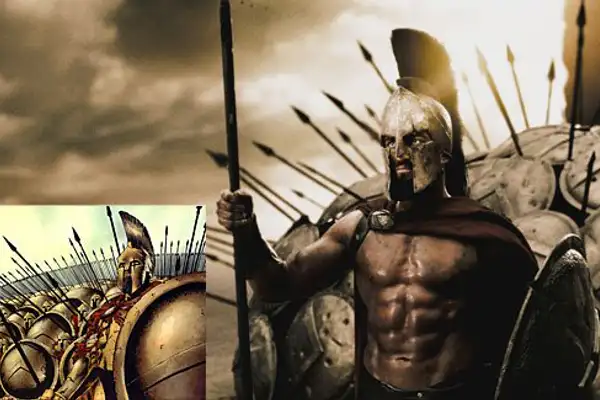
When Sparta consulted the Oracle at Delphi about the Persian invasion, the priestess delivered a brutal answer: either Sparta would be destroyed, or one of its kings would have to die. No loopholes, no escape. Leonidas, one of Sparta's two kings, understood the message instantly. And instead of running from his fate, he decided to fulfill it himself.
He picked 300 Spartans as his personal guard — not the youngest warriors, but men in their prime. Every single one had a living son to carry on his name. Their families were told the truth: these men would not return. And since the religious festival of the Carneia forbade marching to war, Leonidas took them as his "bodyguard" — a clever way around the sacred ban.
At the narrow pass of Thermopylae, 7,000 Greeks prepared to hold the line against the largest army the ancient world had ever seen. For two days, waves of Persian soldiers crashed against the Spartan shield wall and were slaughtered. They say third time's the charm — but for the Persians, each assault was worse than the last. Even the Immortals, Xerxes' elite guard of 10,000, were beaten back.
On the third day, everything changed. A local shepherd named Ephialtes, blinded by Persian gold, revealed a hidden mountain path that could take soldiers behind the Greek lines. When the guards posted on that path were overwhelmed, Leonidas knew the end was coming.
He ordered the bulk of the Greek army to retreat. But 300 Spartans and 700 Thespians refused to leave. The Spartans stayed because their law forbade retreat. The Thespians stayed because their city of Thespiae sat directly in the Persian path — if the pass fell, they lost everything.
The final battle raged around Leonidas's body after the king fell. The Spartans charged four times to recover their king's corpse. When their spears broke, they fought with swords. When their swords broke, they fought with hands and teeth. Not one Spartan surrendered. They died on the hillock where the monument stands today, buried under a rain of Persian arrows.
Leonidas knew from the beginning that he was marching to his death. He chose to die so that Sparta would live. The Oracle's prophecy was fulfilled — a Spartan king fell, and because he did, Sparta endured.