
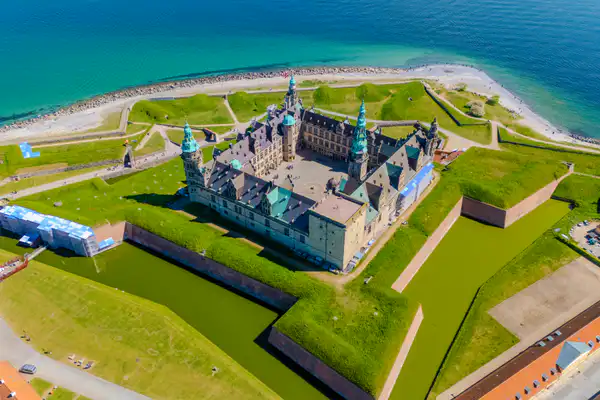
Deep beneath Kronborg Castle, in the cold vaulted casemates where the walls weep with moisture from the Øresund and the only light comes from guttering torches, sits a figure of immense power frozen in stone stillness. This is Holger Danske — Ogier the Dane — the greatest warrior Denmark has ever known, and he has been sleeping for a very long time.
The legend tells that Holger Danske was a knight of Charlemagne's court, a Danish prince who fought alongside the great Frankish emperor in his wars against the Saracens, the Saxons, and every enemy that threatened Christendom. Holger was the mightiest of the paladins, a warrior of such terrifying strength that he could split a man and his horse with a single blow of his sword Curtana. In the chansons de geste, the medieval French epic poems that preserved his deeds, Holger fights with an almost supernatural ferocity, driven by grief and rage after Charlemagne's son kills Holger's own son in a quarrel over a chess game. He wages war against Charlemagne himself until an angel intervenes to make peace between them.
But the Danish tradition takes the legend further, beyond the wars of Charlemagne and into the realm of the eternal. When Holger's earthly battles were done, he did not die. He was carried to the enchanted castle of Morgan le Fay — Avalon in some tellings — where he slept for two hundred years, sustained by Morgan's magic, until he was needed again. Eventually, he returned to Denmark, and descended into the chambers beneath Kronborg Castle, where he sits to this day, his long white beard wound around the stone table before him, his eyes closed, his great sword across his knees.
The legend promises that Holger Danske will remain sleeping as long as Denmark is safe. But should the nation face a threat so terrible that its very existence hangs in the balance, Holger will stir. His beard will pull free from the table where it has grown fast to the stone over the centuries. His eyes will open. He will rise, take up Curtana, and stride out of the casemates into the light of day to defend the land he has protected through centuries of dreaming.
This is not merely a fairy tale. In the crucible of World War II, when Nazi Germany occupied Denmark on April 9, 1940, the legend of Holger Danske became a living force of resistance. The most prominent Danish resistance group adopted the name Holger Danske, carrying out sabotage operations against the German occupiers throughout the war. The sleeping warrior had awakened — not as a single mythical knight but as hundreds of ordinary Danes who chose to fight rather than accept subjugation. They blew up factories producing goods for the German war machine, destroyed railway lines, smuggled intelligence to the Allies, and helped rescue nearly the entire Danish Jewish population — over seven thousand people — by ferrying them across the Øresund to neutral Sweden in October 1943.
The statue of Holger Danske that sits in the casemates today was created by sculptor Hans Peder Pedersen-Dan in 1907, replacing earlier figures. It shows the warrior seated, asleep but not at peace — his posture suggests a coiled readiness, a man who could rise at any moment. Visitors descend into the cold darkness beneath the castle to stand before him, and in the silence of the casemates, the legend feels less like mythology and more like a promise. Denmark has been tested many times since Holger first descended to his underground vigil. Each time, someone has risen to meet the threat. The knight sleeps on, his beard touching the table, waiting for the hour that has not yet come.