
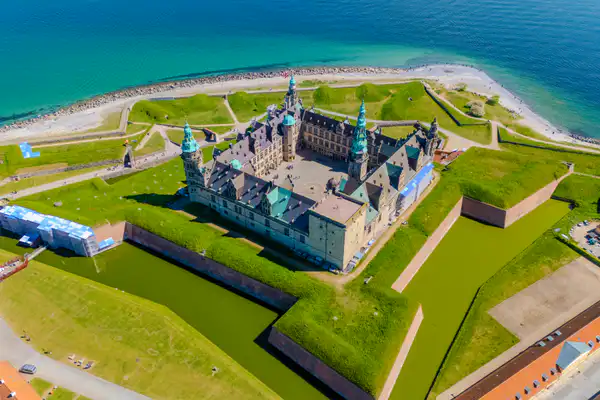
"Something is rotten in the state of Denmark." That line, spoken on the freezing battlements of a castle called Elsinore, is one of the most famous in theater history. The play is Hamlet. The castle is real — it's Kronborg, a massive fortress on Denmark's coast, right where the sea narrows between Denmark and Sweden. Shakespeare wrote it around 1600, and with it, he turned a military stronghold into the most legendary castle on Earth.
Here's the wild part: Shakespeare probably never set foot in Kronborg. He didn't need to. In 1585, Denmark's King Frederick II invited English actors to perform at the castle — and some of them later joined Shakespeare's own theater company, the biggest in London. They came back with stories about the bitter winds, the massive stone walls, and the fog rolling off the sea that made the whole place feel haunted. Shakespeare listened. And then he wrote.
He didn't invent the story from scratch, either. Around 1200, a Danish historian named Saxo Grammaticus wrote down the legend of Amleth — a prince whose uncle murdered his father, married his mother, and stole the throne. Amleth survived by pretending to be insane until he could take revenge. The tale bounced through Europe for centuries, eventually reaching Shakespeare through a French retelling from 1570. Same bones. Completely different animal.
What Shakespeare built from that old legend was on another level entirely. He added a ghost — the murdered king appearing at midnight on the battlements, demanding revenge. He created "The Mousetrap," a play-within-the-play that Hamlet stages to test whether his uncle actually killed his father. He gave us Ophelia, whose heartbreak and madness still wrecks audiences today. And he gave Hamlet the thing that made the character immortal: a prince who thinks too much, feels too deeply, and can't bring himself to act.
"To be or not to be — that is the question." That line isn't just theater. It's the moment someone finally put into words what every person has felt: the crushing weight of being alive when living hurts. Hamlet isn't asking about ending it all in some clinical way — he's asking whether it's braver to keep going or to stop. Shakespeare wrote that over four hundred years ago, and people still reach for it in their darkest moments. That's not just good writing. That's permanent.
And then there's the skull. Hamlet picks up the skull of Yorick — the court jester who made him laugh as a kid — and talks to it. It's the moment where death stops being an idea and becomes personal. Someone he loved is now just bone in his hands. That image — a man holding a skull, facing the fact that everyone he's ever known will end the same way — is one of the most recognized in all of art. Four hundred years, and it still hits.
Today, Kronborg Castle hosts live performances of Hamlet right on its grounds. Laurence Olivier, Kenneth Branagh, and Jude Law have all played the prince here, delivering Shakespeare's lines on the real battlements, above the real sea. The castle and the play have become so tangled together that you can't think of one without the other. Walk those walls on a foggy night and tell me you don't feel the ghost.
Shakespeare never visited Kronborg. He wrote about a fictional prince in a real castle, and four centuries later, that prince feels more alive than most actual historical figures. The stones are Danish. The story is English. But the questions Hamlet asks — about justice, about grief, about whether doing the right thing is even possible when you can barely get out of bed — those belong to everyone.