
Herod the Great was afraid of everyone. As King of Judea from 37 to 4 BCE -- a title granted not by his own people but by the Roman Senate, enforced not by Jewish consent but by Roman legions -- he lived in a state of perpetual terror that was, in fairness, entirely rational. His own subjects despised him. He was an Idumean, an Edomite, from a family forcibly converted to Judaism only a generation earlier. The Hasmonean dynasty he had displaced still commanded fierce loyalty, and whispers of restoration never ceased. His marriage to the Hasmonean princess Mariamne I was meant to shore up his legitimacy, but it only deepened the web of court intrigue; he would eventually execute her, along with her mother, her grandfather, and two of his own sons by her. Beyond his own borders, Cleopatra VII of Egypt coveted his kingdom with an appetite that was political, territorial, and deeply personal. She had already persuaded her lover Mark Antony to strip Herod of the lucrative balsam groves of Jericho and transfer them to her. She wanted all of Judea. If Antony granted her wish -- and Antony, besotted, seemed capable of granting her anything -- Herod would need somewhere to run. Somewhere unreachable, unassailable, where no army could follow and no assassin could find him. He looked south, toward the Dead Sea, and he found a rock.
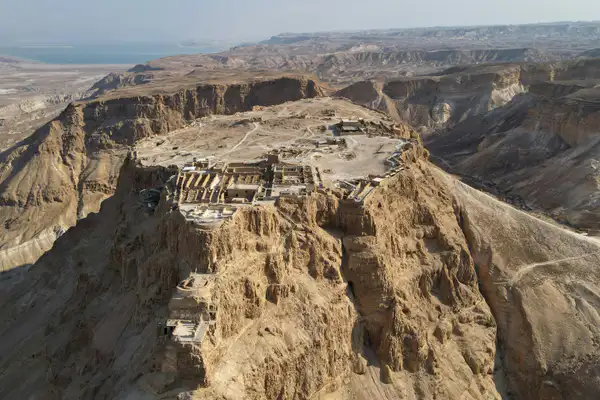
Masada was already a fortress when Herod claimed it. The Hasmonean kings had fortified the plateau in the second century BCE, recognizing the staggering natural advantages of a flat-topped mesa rising roughly four hundred meters above the western shore of the Dead Sea -- itself the lowest point on the surface of the Earth, more than four hundred meters below sea level. The summit was boat-shaped, approximately six hundred meters long and three hundred meters wide, encompassing about twenty-three acres of flat ground surrounded on every side by sheer cliff faces dropping into deep ravines. There were only two approaches: the Snake Path on the eastern face, a winding trail of switchbacks so narrow and vertiginous that Josephus would later write 'the least slip is fatal,' and a somewhat less treacherous path on the western side. Herod looked at this geological impossibility and saw not merely a refuge but an opportunity for something that only a mind like his could conceive -- a palace of Roman luxury, a statement of absolute power, built in the most inhospitable location imaginable. He did not simply want to survive on Masada. He wanted to live there as a king, with every comfort that Rome's finest architects and engineers could provide, perched on a rock in a desert where the annual rainfall measured barely two inches and the summer heat could kill an unprotected man in hours.
The Northern Palace is Herod's masterpiece, and it remains one of the most audacious architectural achievements of the ancient world. Built on three natural rock terraces stepping down the northern cliff face, it appears to hang in mid-air above the desert. The upper terrace, at the plateau's edge, contained Herod's private living quarters -- four rooms with floors of black-and-white geometric mosaics, carefully designed without human or animal figures to respect Jewish aniconism, and walls painted with frescoes imitating panels of cut marble. A large semicircular balcony jutted outward, offering a panoramic view north and east across the Dead Sea to the Mountains of Moab in what is now Jordan. Twenty meters below, connected by a stairway cut directly into the living rock, the middle terrace held a circular pavilion roughly fifteen meters in diameter -- a tholos, likely roofed with a conical structure, used as a reception and dining space where Herod could entertain favored guests suspended between earth and sky. Another fifteen meters below that, the lowest terrace opened onto a nearly square banqueting hall approximately eighteen meters on each side, surrounded by Corinthian columns plastered and painted to resemble marble. The walls of this lowest level bore elaborate frescoes in the Pompeian Second Style -- panels of deep red, green, yellow, and black imitating colored marble, separated by painted architectural elements. When Yigael Yadin's volunteers carefully cleaned these frescoes in 1963, the colors emerged as vivid as anything found at Pompeii itself, preserved by two thousand years of desert air. A small private bathhouse was attached to this level, because even at the bottom of a cliff in the wilderness, Herod required a hot bath.
The Western Palace, on the opposite side of the plateau, was even larger -- approximately four thousand square meters, the biggest building on Masada and the largest of all Herod's palaces anywhere in his kingdom. This was the official, ceremonial center: a throne room, reception halls, administrative offices, and royal apartments arranged around a central courtyard in four distinct wings. Its floors held the most elaborate mosaics found on the site -- geometric and vegetal designs incorporating olive branches, vine leaves, and pomegranates in colored stone tesserae, among the earliest known decorative mosaics in the Land of Israel. Three additional smaller palace-villas were also built on the summit, likely for family members and high-ranking officials. And surrounding the entire plateau, a massive casemate wall stretched for fourteen hundred meters -- two parallel walls with approximately seventy rooms built into the space between, punctuated by thirty towers and three fortified gates. The rooms served as barracks, storage, and, seventy years later, as the living quarters of the families who would die here. But it was the engineering beneath the luxury that truly defied belief. Masada receives an average of fifty millimeters of rain per year -- barely two inches. Herod's engineers solved this by building a system of low dams across two seasonal wadis on the mountain's northwestern face, capturing the rare but intense flash floods and channeling the water through rock-cut aqueducts into twelve enormous cisterns carved into the cliff. The total capacity of this system was approximately forty thousand cubic meters -- over ten million gallons -- enough to sustain a large garrison for years. Water was carried from the lower cisterns up to the summit by servants and pack animals. And what did Herod do with this impossibly precious resource, hauled hundreds of meters upward through the desert? He filled a swimming pool. An open-air swimming pool roughly eighteen meters long by twelve meters wide, with plastered walls and steps for entry, surrounded by a pleasure garden. In one of the driest environments on Earth, on top of a cliff, the King of Judea went swimming.
The rest of the fortress was equally meticulous. A massive casemate wall -- two parallel walls with approximately seventy rooms built into the space between them -- encircled the entire summit for fourteen hundred meters, punctuated by thirty towers and three fortified gates. The main bathhouse near the Northern Palace followed the classical Roman sequence: an apodyterium for changing, a tepidarium for warming, a caldarium with a sophisticated hypocaust system of some two hundred small clay pillar stacks supporting a raised floor through which hot air from an external furnace circulated -- underfloor heating, in the desert, at the edge of the world. When Yadin excavated the caldarium, many of the tiny clay pillars were still standing in their original positions after nearly two millennia. Twenty-nine long, narrow storerooms lined up near the Northern Palace, each roughly twenty-five meters long by four meters wide, held Herod's strategic reserves: grain, wine, oil, dates, and pulses sufficient for years, plus armories stocked with hundreds of iron arrowheads, stone ballista balls, and pieces of armor. Amphora handles found among the stores bore Latin inscriptions and stamps, including one addressed 'To King Herod of Judea' with a consular date of 19 BCE -- Italian wine shipped across the Mediterranean from Campania, overland through the Judean hills, and hauled up the Snake Path so that the king could drink vintage on a cliff in the desert. A pigeon columbarium with hundreds of small nesting niches provided both a source of fresh food and, possibly, a means of communication by carrier pigeon -- because even communication was engineered into this fortress. When Yadin excavated these storerooms in 1963, he found that many storage jars still contained carbonized food residue, and the dry desert climate had preserved organic materials -- dates, grain, textile fragments -- that had survived nearly two thousand years. Three additional smaller palaces were built for family members and officials. A pigeon columbarium with hundreds of nesting niches provided both food and, possibly, communication. Herod left nothing to chance and spared no expense. He built, in the most impossible location his kingdom offered, a self-sustaining world of total luxury and total security.
And then he never used it. There is no evidence that Herod ever fled to Masada. Cleopatra's threat evaporated when she and Antony were defeated at the Battle of Actium in 31 BCE and both committed suicide the following year. Herod shrewdly switched his allegiance to the victor, Octavian -- the future Augustus -- and ruled for another twenty-seven years, dying of a gruesome illness in 4 BCE at his palace in Jericho. Masada stood empty, a monument to one man's paranoia, maintained by a small garrison, its storerooms slowly filling with dust, its frescoes unseen, its swimming pool dry. Seventy years later, the people Herod feared most -- Jewish rebels -- seized his fortress at the start of the Great Revolt against Rome. The Sicarii, under Eleazar ben Ya'ir, found the storerooms still stocked, the water system still functioning, the walls still strong. They partitioned Herod's gilded casemate rooms with rough stone walls to create family apartments. They built mikvaot -- ritual immersion baths -- where Herod had built pleasure pools. They established a synagogue in a room Herod had used for other purposes, orienting it toward the ruined Temple in Jerusalem. They read scrolls of Ezekiel in a palace built by a king who would have had them executed. The greatest irony of Masada is that the fortress built by a half-Jewish tyrant to protect himself from his own people became the final sanctuary of the very rebellion he would have crushed. Herod's ghost, if it lingered in the painted corridors and mosaic halls, must have known the deepest bitterness -- his masterpiece fulfilled its purpose at last, but for the wrong side.