
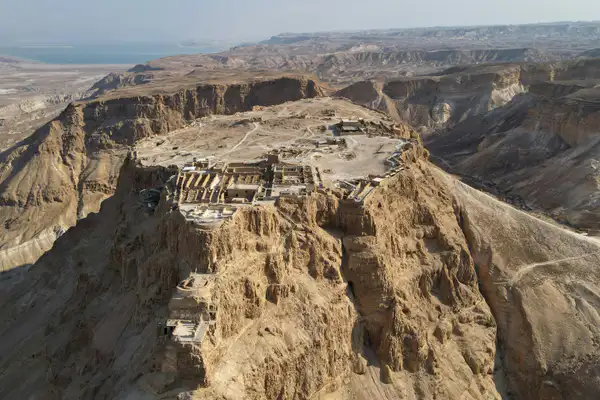
In the spring of 73 CE, Rome's Tenth Legion finally smashed through Masada's outer wall — they'd spent months building a ramp up the cliff to reach it. The defenders threw up a backup wall of wood packed with earth. When the ram couldn't break it, the Romans lit it on fire. The wind briefly blew flames toward Rome's own siege tower. Then it shifted. By nightfall, the wall was gone. Everyone knew what dawn would bring: ten thousand soldiers through the gap. No more walls. Only a choice.
These weren't random refugees. They were the Sicarii — "dagger men" — the most extreme Jewish rebel faction. Seven years earlier, Roman soldiers looted Jerusalem's Temple and massacred civilians. Judea revolted. The rebels won early victories, destroying a full legion. Rome sent sixty thousand troops. Every stronghold fell. Jerusalem burned. The Temple was destroyed. Masada was the last holdout — 960 people on a fortress above the Dead Sea, surviving on century-old food left by King Herod.
That night, their leader Eleazar ben Ya'ir gathered everyone in Herod's palace. Josephus — a Jewish commander who defected to Rome and wrote the only surviving account — says Eleazar gave two speeches. He described what awaited: men dying in Roman mines and arenas, women violated, children raised as slaves. "Let our wives die unabused," he said. "Our children without knowledge of slavery." He wasn't asking them to give up. He was asking them to make the last free choice they'd ever have.
Men wept. Some held their wives and couldn't let go. But Eleazar pressed on. Look around, he told them — at the burning wall, the Roman camps circling the base like a noose. There was nothing to negotiate. Rome didn't show rebels mercy. It made examples. Everyone knew about the crucifixions after Jerusalem fell — so many the soldiers ran out of wood for crosses. Captured Jews had been paraded through Rome's streets like trophies. Not all at once, not without tears, they agreed.
What happened next was systematic. Jewish law forbids suicide, and they knew it. So they designed a method where only one person would take his own life. Each man went to his family, held them, and killed them. They burned their possessions but left the food stores untouched — a message to Rome: we didn't starve, we chose this. Ten men were picked by lot to kill the rest. Those ten drew lots again. The last man set the palace ablaze and drove his sword through himself.
At dawn, soldiers charged through the breach — shields locked, swords drawn, braced for the worst fight of their lives. Instead: silence. Josephus calls it "a dreadful solitude on every side, with a fire within the palace." They shouted. Banged swords on shields. Nothing. Then two women and five children crawled from a hidden cistern. One was Eleazar's relative. She told the Romans everything. These veterans — men who'd burned Jerusalem's Temple — stood speechless before the dead.
Here's what's strange: for two thousand years, the rabbis who shaped Judaism never mentioned Masada. Not once. They picked a different hero — a scholar who talked his way out of besieged Jerusalem and built a tradition of learning that survived without a temple or a homeland. Masada's swords and fire were everything they rejected. But the story survived. That silence the Romans found — of people who chose death over kneeling — still echoes across the plateau, unanswerable and absolute.