
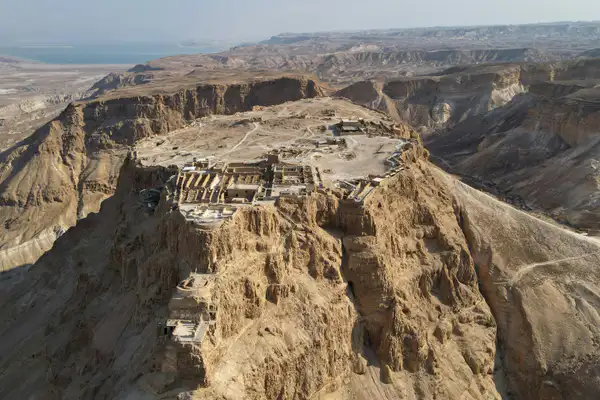
In the winter of 73 CE, a Roman general named Flavius Silva stood at the base of a cliff and looked up. Four hundred meters above him, on a flat-topped rock called Masada, 960 Jewish rebels held the last fortress standing against Rome. Jerusalem had fallen three years earlier. The Second Temple — the heart of Jewish worship — burned to nothing. Every other stronghold had surrendered. But this rock in the Judean Desert refused to fall.
Silva didn’t rush. He was a career soldier who’d later become consul — one of Rome’s highest offices — and he ran this siege with terrifying patience. First, he sealed the mountain off. His men built a wall around the entire base, nearly five kilometers long, with guard towers and eight fortified camps. No one got in or out. Those camps are still visible from Masada’s summit today — outlines pressed into the desert floor like a ghost army frozen in stone.
Now came the real problem: how do you move an army up a four-hundred-meter cliff? The eastern path was too narrow for troops. But on the western side, a natural rock ledge stuck out a hundred meters below the summit. Silva’s engineers decided to build a ramp from there to the wall — seventy-five meters of packed earth, crushed stone, and timber, wide enough for a battering ram. It was one of the most ambitious builds Rome ever attempted.
Here’s where it gets dark. The workers hauling rock up that slope weren’t just soldiers. They were Jewish prisoners of war — captured in earlier battles, now forced to build the weapon that would kill their own people. The defenders could see them from the summit. And Rome knew it. By placing Jewish laborers in the most exposed spots, they made sure no one on top could fight back without killing their own. It was calculated cruelty dressed up as engineering.
For months, the ramp climbed. In desert heat past forty degrees, with water hauled from springs ten kilometers away, the work never stopped. The defenders could only watch. Every morning, the ramp was a little closer. Every evening, their future was a little shorter. No rescue was coming. Just the slow, grinding certainty that Rome would reach them — not through speed or surprise, but through sheer, terrifying patience.
When the ramp reached the wall, Silva rolled up a siege tower — iron-plated to block fire arrows — and started swinging a battering ram. The outer wall cracked and crumbled. Behind it, the defenders had packed earth between timber to absorb what stone couldn’t. The ram bounced off. So Silva set it on fire. The wind shifted once, blowing flames toward the Romans. Then it turned, and the last barrier burned to nothing. By nightfall, only open air stood between Rome and Masada.
At dawn, the Tenth Legion charged through the breach. They found silence. According to the historian Josephus, the 960 defenders had taken their own lives rather than surrender to Rome. Silva had spent months building one of history’s greatest siege works, deployed an entire legion, and moved tens of thousands of tons of earth — all to reach fewer than a thousand people. When the ramp brought him to the top, there was no one left to conquer.
That ramp still stands. Two thousand years of wind, floods, and earthquakes haven’t brought it down. With the camps and siege wall, it forms the most complete Roman siege system ever found — better preserved than even Caesar’s famous works at Alesia in France. You can walk beside it today, look down from the summit, and see an empire’s obsession still pressed into the desert floor. Rome spent more to make a point than the point was ever worth.