
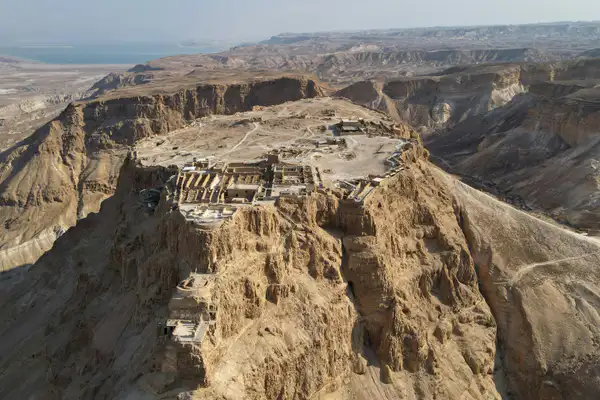
For nineteen centuries, the Jewish people forgot Masada. Complete silence. The Talmud -- that vast ocean of rabbinic thought underpinning Jewish religious life -- never mentions it. Not once. The sole surviving account belongs to Josephus, a Jewish general who surrendered to Rome and lived in comfort while his people were sold into slavery. Jewish tradition branded him a traitor. His book was preserved not by Jewish scribes but by Christian monasteries. The rabbis who rebuilt Jewish civilization after Rome destroyed the Temple in 70 CE made a deliberate choice: they picked Yavneh, not Masada. At Yavneh, a sage had negotiated with the Romans to open an academy. Study instead of swords. Adaptation instead of death. They built a portable civilization of text and law that survived two thousand years without land or army.
The resurrection of Masada began with a poem. In 1927, Yitzhak Lamdan -- a Ukrainian writer who'd fled to Palestine from the pogroms of the Russian Civil War -- published an epic titled simply Masada. It wasn't a historical account. It was a metaphor: Palestine as the last fortress, the final refuge after every door in the world had slammed shut. Lamdan's brother had been killed in a pogrom. He knew what happened when Jews had nowhere to run. From his poem a phrase was born that became a battle cry: Metzada lo tipol shenit -- 'Masada shall not fall again.' Within a decade, every school in Jewish Palestine taught it, and Masada had gone from a forgotten footnote to the emotional heart of a people being born.
But a poem needed a place. Shmaryahu Gutman provided one. Educator, archaeologist, and commander in the Palmach -- the elite force that would become the core of the future Israeli army -- Gutman understood the power of landscape. From the 1930s onward he organized treks for Zionist youth: days of marching through the Judean Desert, climbing the Snake Path by torchlight in darkness, arriving at the summit at dawn. There, with the Dead Sea shimmering below, he read from Josephus -- edited versions that left out the Sicarii's massacre of civilians -- and recited Lamdan. Oaths of loyalty were sworn. The ritual was almost religious: darkness to light, exile to redemption.
They say the third time's the charm. Masada had its ancient fall, then nineteen centuries of oblivion. The third time brought not destruction but the most spectacular resurrection. After Israeli independence in 1948, the state turned Masada into official ceremony. Armored Corps recruits climbed the mountain at night, received a rifle in one hand and a Hebrew Bible in the other, and at sunrise shouted into the desert: 'Masada shall not fall again!' Every soldier felt they stood where the last defenders had stood. For decades, it was one of the most powerful rituals in Israeli military culture.
The cracks appeared slowly and then all at once. In 1966, Trude Weiss-Rosmarin published a devastating essay: 'Masada or Yavneh?' Her argument was simple but lethal. The rabbis at Yavneh, who chose study and survival, ensured Jewish continuity for two millennia. The Sicarii at Masada, who chose death, ensured nothing but their own extinction. Which model should a modern state follow? The Lebanon War of 1982 deepened the doubts. The First Intifada in 1987 deepened them further. By the 1990s, the IDF had quietly moved its main oath ceremonies away from Masada to Latrun. No official announcement. As if the institution was embarrassed by a tradition it could no longer fully embrace.
In 1995, sociologist Nachman Ben-Yehuda published The Masada Myth, documenting with ruthless precision how the narrative had been deliberately constructed by poets, educators, military leaders, and politicians serving ideological purposes. The Sicarii were terrorists who massacred seven hundred Jewish civilians at Ein Gedi. Mass suicide violated Jewish law. Josephus was unreliable. The celebrated archaeologist Yadin had shaped his findings to fit the national story. The concept of the 'Masada complex' entered political vocabulary -- the all-or-nothing mentality that turns every conflict into a last stand and makes peace impossible.
Today Masada stands wrapped in layers of meaning that neither Lamdan nor Gutman could have imagined. UNESCO inscribed it as a World Heritage Site in 2001, in carefully neutral language. About three-quarters of a million people climb the mountain each year -- some on the Snake Path before dawn, most by the cable car installed in 1971. Israeli school groups still come, but their teachers tell a more complicated story. American Jewish teenagers celebrate Bar and Bat Mitzvahs in the ancient synagogue. And somewhere in the Israel Museum, behind glass, eleven pottery shards with scratched names sit in silence -- as they have waited for two thousand years -- for someone to decide what they mean.