
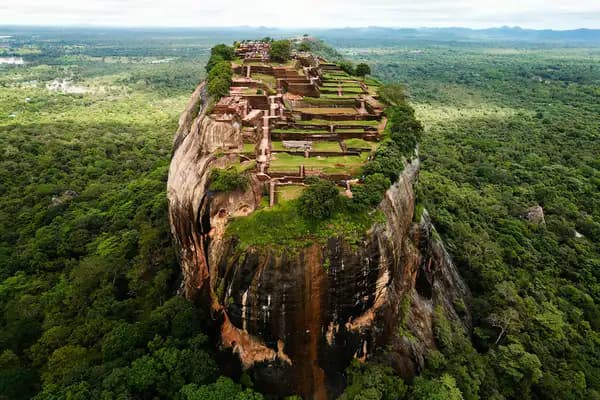
Halfway up a 200-meter rock in Sri Lanka's jungle, tucked into a sheltered pocket in the cliff, nineteen women have been watching from the stone for about 1,500 years. They're painted right onto the rock — golden-skinned and bare above the waist, heavy with pearls and gold. Clouds swirl around their hips, hiding everything below. Some carry flowers. Some carry offerings. Some look straight at you with a half-smile that's somehow inviting and distant at the same time. Nobody knows who they are.
And here's what makes it stranger: these nineteen are all that's left. The original covered the rock's entire western face — over 5,000 square meters — with more than 500 figures. Picture hundreds of golden women in painted clouds, from the base gardens to the fortress gates. This was the work of King Kashyapa I, who seized Sri Lanka's throne from his own father around 477 AD and turned this rock into his royal capital. Five hundred women on a cliff. Now there are nineteen.
So who are these women? Scholars have been arguing for a century. The first theory: they're real women from Kashyapa's court — queens, lovers, attendants — carrying offerings to a nearby temple. That explains the trays but not the clouds. Why would real women float in clouds? The second theory: they're heavenly beings from Hindu and Buddhist mythology who live among the clouds and shower flowers on the earth below. That fits perfectly and gave the paintings their famous name — the Cloud Maidens.
But the most creative answer came from Sri Lanka's greatest archaeologist, Senarath Paranavitana. He spent decades studying the site and concluded they weren't people or goddesses at all — they were the weather. The dark-skinned figures were rain clouds. The fair-skinned ones were lightning. Together, they were the tropical storm that rolls around the rock every monsoon season, painted right onto the cliff face. Kashyapa didn't just build a fortress on this rock. He painted his own sky.
The paintings have survived 1,500 years of tropical monsoons. The original builders carved drip channels into the rock to redirect rainwater, and they still work today. But nature wasn't the worst threat. In 1967, vandals attacked the paintings — hacking parts off two figures and smearing green paint across fifteen others. The damage couldn't be undone. Of more than 500 original figures, just nineteen remain in their pocket in the cliff, colors still warm after fifteen centuries.
Here's what gets people: after all the theories, nobody can prove who these women are. They just float there in their painted clouds, loaded with gold, looking at you with a half-smile that gives nothing away. Archaeologists found tiny clay copies of them at the base of the rock — souvenirs, sold to visitors as early as the sixth century. People have been climbing this rock for 1,500 years, leaving with more questions than answers. The Cloud Maidens keep their secret. They always have.