
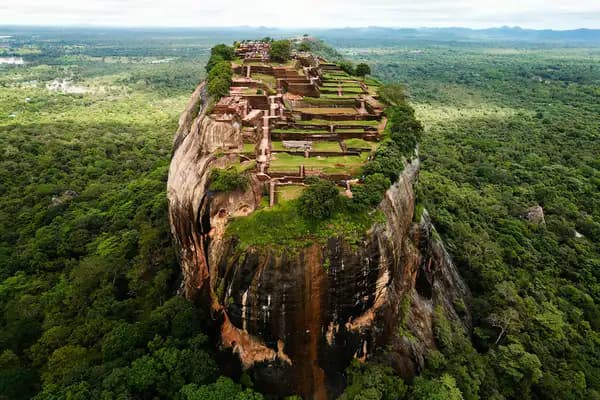
Kashyapa killed his own father. That’s where this starts. In 477 CE, he overthrew King Dhatusena of Sri Lanka — had him sealed alive inside a wall — and took the throne. But his half-brother Moggallana, the rightful heir, escaped that same night. A teenage prince running through darkness toward South India. Kashyapa knew he’d come back. So he built a palace on top of a 200-meter rock in the middle of the jungle. A fortress no army could reach.
For eighteen years, Kashyapa ruled from the sky. He surrounded Sigiriya with moats, carved a giant lion into the rock as his front gate, and painted the walls with golden goddesses. Every staircase, every arrow slit, every chokepoint was built for one thing: the day his brother came back with an army. And when that day finally arrived in 495 CE — Moggallana marching in with South Indian troops and a throne to reclaim — Kashyapa did the last thing anyone expected.
He came down. Instead of waiting behind the walls he’d spent two decades building, Kashyapa marched his army onto the open plain. Maybe he thought he’d win fast. Maybe he knew hiding would make him look weak. Or maybe — after eighteen years of living with what he’d done — he just wanted it over. The man who built a fortress in the sky chose to fight on the ground.
The armies clashed below the rock. Kashyapa rode his war elephant at the center, visible to everyone. Then it happened. His elephant hit marshy ground and turned sideways to find better footing. Just an animal avoiding mud. But his soldiers saw their king turning away — and they saw retreat. Migara, the same commander who’d helped Kashyapa kill his father, had been waiting for exactly this. He called the retreat, and the whole army broke. Within minutes, Kashyapa was completely alone.
What happened next is the most famous death in Sri Lankan history. Kashyapa drew a jeweled dagger from his waist, pressed it to his throat, and cut. But here’s the detail that’s haunted people for fifteen hundred years: after slashing his own throat, he raised the bloody dagger above his head so the whole battlefield could see. Then he slid it back into its sheath. And fell. He sheathed the blade because the fight was over. The account was closed.
Moggallana took the throne and moved the capital back to Anuradhapura, the ancient sacred city. Sigiriya — this impossible fortress, this monument to guilt and genius — was handed to Buddhist monks. The pleasure palace of a father-killer became a monastery. The painted goddesses gazed down on shaved heads. The fountains went quiet. The lion crumbled. For fourteen centuries, the only sounds on that rock were monks chanting and visitors scratching love poems into the polished Mirror Wall.
The Buddhist take on Kashyapa is brutal and simple: karma doesn’t wait for your next life. He was brilliant. His fortress was a marvel. But the crime came for him anyway — not through the walls he’d built, but through the loyalty he could never earn. The army that broke that day had never truly followed a king who’d killed his own father. You can build your fortress as high as you want. The fall is always waiting.