
About
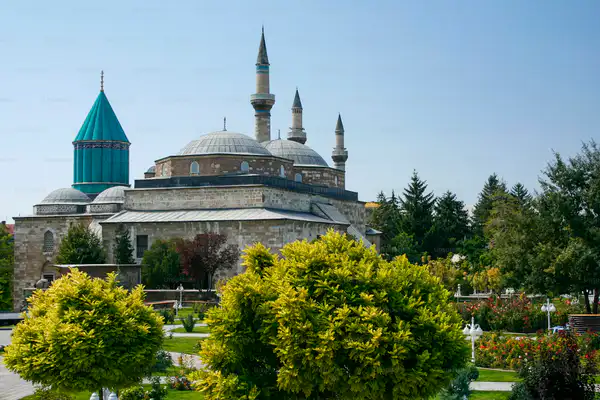
s father, Bahaeddin Veled, who died in 1231. When Rumi himself died on December 17, 1273, he was buried beside his father. His successor Husameddin Çelebi commissioned the architect Badr al-Din Tabrizi to construct the magnificent mausoleum (Kubbe-i-Hadra) in 1274, completed by Gürcü Hatun. The Green Dome rises 25 meters high, featuring a 16-sectioned cylindrical body topped with a 16-sectioned conical spire, all covered in turquoise tiles that shimmer in the Anatolian sun. Over the centuries, Ottoman sultans expanded and embellished the complex. Sultan Murad III added 17 dervish cells in 1584. Sultan Süleyman the Magnificent built the Semahane (Ritual Hall) for the sacred whirling ceremony. The complex includes the Sacred Kitchen (Matbah-ı Şerif), where dervish initiates underwent 1,001 days of spiritual training, and a library housing rare manuscripts including 14th-century copies of Rumi's Masnavi and Divan-i Kebir. The museum displays extraordinary artifacts: Rumi's personal garments, the original Masnavi manuscripts, musical instruments (ney flute, kemence, rebab), and a casket containing strands of the Prophet Muhammad's beard. The sarcophagus covering Rumi's tomb is embroidered in gold with Quranic verses, a gift from Sultan Abdul Hamid II in 1894. Rumi's teachings transcended religious boundaries — he wrote: "Come, come, whoever you are. Wanderer, worshipper, lover of leaving. It doesn't matter. Ours is not a caravan of despair." His funeral was attended by Muslims, Christians, Jews, and Zoroastrians, each reciting from their own scriptures. When asked why non-Muslims came, they replied: "He was our sun too." This universal love is embodied in the museum itself — a place where people of all faiths find peace.
Historical Significance
“The Mevlana Museum represents the spiritual heart of Sufism and one of the most important pilgrimage sites in the Islamic world. Rumi's transformation from a respected Islamic scholar into a mystical poet began in 1244 when he met Shams of Tabriz, a wandering dervish who became his spiritual soulmate. After Shams mysteriously disappeared (possibly murdered by jealous disciples), Rumi channeled his grief into an outpouring of poetry that became the Masnavi — a six-volume masterpiece considered by many to be divinely inspired. The complex evolved from a simple tomb into a major dervish lodge (tekke) of the Mevlevi Order, founded by Rumi's son Sultan Veled. The Mevlevi Order, known as the Whirling Dervishes, spread across the Ottoman Empire and became one of the most influential Sufi orders in history. The Sema ceremony — the sacred whirling ritual — was performed in the Semahane for over 700 years until the order was suppressed in 1925. In 1926, Mustafa Kemal Ataturk converted the complex into a museum, preserving its spiritual and cultural heritage. The museum now serves as both a historical monument and a place of pilgrimage, attracting visitors from around the world who seek the wisdom and universal love that Rumi embodied.”
Stories
3History
👑 Built by
Husameddin Çelebi (Architect: Badr al-Din Tabrizi), expanded by Ottoman sultans
1231 - Rumi's father Bahaeddin Veled dies and is buried in the rose garden gifted by Sultan Alaeddin Keykubad I
1244 - Rumi meets Shams of Tabriz, beginning his transformation into a mystical poet
December 5, 1247 - Shams of Tabriz mysteriously disappears (possibly murdered)
December 17, 1273 - Rumi dies and is buried beside his father; his death is commemorated as Şeb-i Arus (Wedding Night)
1274 - Husameddin Çelebi commissions the Green Dome mausoleum, designed by Badr al-Din Tabrizi
1397 - Karamanid ruler Ala' al-Din Ali Bey replaces the dome with the current 16-sided conical crown
1520-1566 - Sultan Süleyman the Magnificent builds the Semahane (Ritual Hall)
1584 - Sultan Murad III adds 17 dervish cells
1894 - Sultan Abdul Hamid II gifts the gold-embroidered sarcophagus covering
1925 - Mevlevi Order suppressed by the Turkish Republic
1926 - Converted into a museum by Ataturk
2005 - UNESCO recognizes the Mevlevi Sama Ceremony as Intangible Cultural Heritage
2022 - Becomes Turkey's most visited museum with 3 million annual visitors