
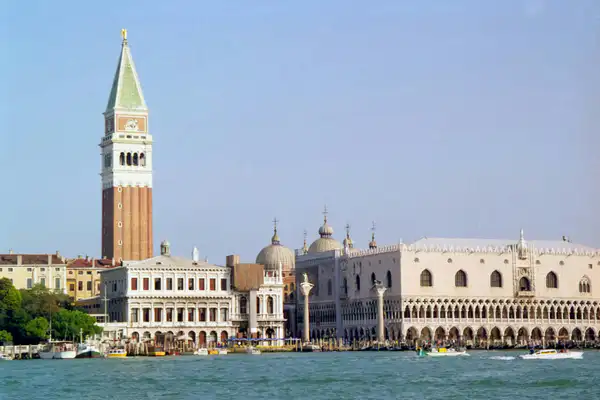
Once a year, for almost 800 years, the leader of Venice did something no other ruler in history ever tried — he married the ocean. Not as a joke. Not as a metaphor. As an official act of government. The Doge, Venice’s elected ruler for life, would board a massive golden barge, sail out to the open Adriatic, pull a gold ring off his finger, and drop it into the waves. His declaration: “We wed thee, Sea, as a sign of true and permanent rule.” And he meant every word.
It started around the year 1000. Venice was a young city built on stilts in a lagoon, and pirates from the coast of what’s now Croatia were choking its trade routes. So Doge Pietro Orseolo II sailed the whole Venetian fleet across the Adriatic, crushed the pirates, and seized the coast. He came home on Ascension Day — a major Christian holiday — and celebrated by sailing to open water and claiming the sea itself as Venetian property. Every Doge after him repeated the vow, same day, every year.
The ceremony got an upgrade in 1177. Pope Alexander III was on the run from the Holy Roman Emperor Frederick Barbarossa — at the time, the most powerful man in Europe — and Venice gave him shelter and brokered a peace deal. The grateful Pope handed the Doge a golden ring and declared that Venice now had God’s own blessing to “wed” the Adriatic each year. They called it the Sposalizio del Mare — the Wedding of the Sea. It wasn’t just a power play anymore. It was sacred.
The real showstopper was the Bucintoro — the Doge’s ceremonial barge. The final version, built in 1729, stretched 35 meters long, coated in gold leaf, draped in red silk, and rowed by 168 oarsmen. Foreign diplomats wrote home that nothing in Europe — no coronation, not even the spectacles at Versailles — could match this golden ship gliding across the water, trailed by hundreds of boats, the Doge standing at the front like a groom walking down the aisle.
The last real ceremony took place on Ascension Day, 1797. Twelve days later, Napoleon’s army marched into Venice and the republic voted to dissolve itself — ending 1,100 years of unbroken self-rule. Napoleon knew exactly what he was doing next. He had the Bucintoro’s gold stripped and melted down, then set fire to what was left. The ashes of the most stunning ship ever built were dumped into the same water it had once sailed in triumph. He didn’t just conquer Venice. He burned its wedding dress.
The ceremony was brought back in the 1900s and still happens every year — though now it’s the mayor, not a Doge, who tosses the ring. Think about what that means: somewhere on the floor of the Adriatic, beneath the waves off the Venice coast, there are roughly 800 years of gold rings sitting in the mud. The price a republic paid, year after year, to stay married to the sea. And for a thousand years, Venice kept its vows.