
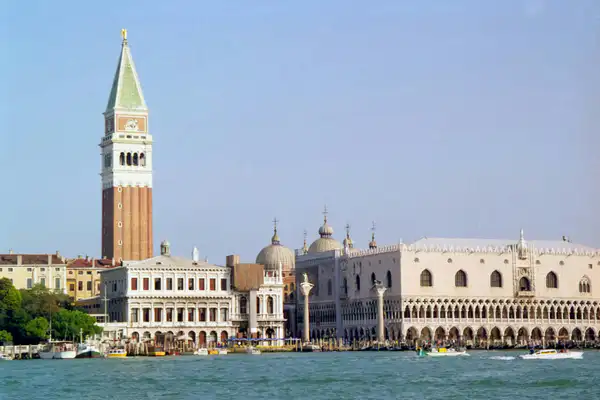
Venice, 828 AD. The city was growing fast — rich from trade, building a fleet, becoming a real power in the Mediterranean. But it had a problem. Its patron saint was Theodore, a Greek soldier-saint that nobody outside the church cared much about. If Venice wanted to stand alongside Rome and Constantinople, it needed a bigger name. And two Venetian merchants trading in Alexandria, Egypt — Buono da Malamocco and Rustico da Torcello — decided they knew exactly where to find one.
Their target was St. Mark the Evangelist — one of the four Gospel writers and the man who founded the Church of Alexandria. His body had been resting in a church there for centuries. The merchants weren’t in town to pray. They were there to steal a saint, smuggle him across the sea, and deliver him to Venice as its new protector. It was one of the boldest heists in history — and the plan they came up with was even crazier than the idea itself.
Alexandria was under Abbasid Muslim rule, and the authorities watched Christian relics closely — they knew Europeans would do anything to get their hands on them. So the merchants found allies inside the church: two Greek monks named Stauracio and Teodoro, who guarded St. Mark’s tomb. The monks had their own reason to help. The Caliph had been tearing down Christian churches and reusing the marble, and they were terrified St. Mark’s church would be demolished next.
Under cover of night, the four men cracked open the sarcophagus, pulled out St. Mark’s remains, and swapped in the body of a lesser-known saint — Claudia. Then came the genius move. They packed Mark’s body into a large basket and buried it under layers of pork and cabbage. When Muslim customs officials boarded the ship, the merchants threw open the basket and shouted “Khinzir! Khinzir!” — Arabic for “Pork! Pork!” The officials, for whom pork was strictly forbidden, recoiled in disgust and waved the ship through without a second look.
And just like that, one of Christianity’s holiest relics sailed out of Egypt — hidden under meat that its guards’ own faith wouldn’t let them touch. When the body reached Venice, the city erupted. Doge Giustiniano Partecipazio ordered a basilica built on the spot. The first one went up by 832 AD. The breathtaking one standing today — St. Mark’s Basilica — was built between 1063 and 1094. And the winged lion of St. Mark, a symbol from the biblical Book of Revelation, became Venice’s emblem — stamped on flags, carved into walls, painted on warships.
Here’s the wildest part. If you visit the basilica today, look up at the mosaic above the far-left entrance. It’s from the 1200s, and it shows the entire smuggling scene in vivid detail — the merchants carrying the basket, the officials turning away, the saint’s body hidden under forbidden meat. It might be the only church on Earth whose front door proudly celebrates a crime.
But Venice never called it a crime. They called it a translatio — a “sacred transfer” — and insisted God himself had willed it. According to their legend, centuries before the theft, an angel appeared to Mark as he sailed through the Venetian lagoon and whispered: “Peace to you, Mark. Here your body shall rest.” The theft of 828, they said, wasn’t theft at all. It was a prophecy finally coming true. And honestly? A thousand years of Venetian glory was built on that story.