
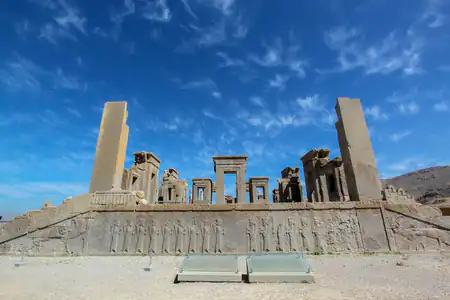
In May of 330 BCE, Alexander the Great threw a banquet in a palace he had no right to own. Persepolis — the ceremonial heart of the Persian Empire, the most magnificent building complex on earth — had been in his hands for four months. Wine was flowing. Torches flickered against walls carved with images of twenty-three nations bringing gifts to the King of Kings. Then a woman named Thais stood up and changed everything with a single speech.
Thais was Athenian — brilliant, educated, the companion of Ptolemy, one of Alexander's top generals. Her argument cut straight to the bone. A hundred and fifty years earlier, the Persian king Xerxes had invaded Greece and burned the sacred temples of Athens to the ground. Now here they sat, inside his palace, drinking his wine. The greatest thing Alexander could do, she said, was let her — a woman of Athens — light the first flame. The room of drunk Macedonian soldiers went wild.
Alexander grabbed a torch. What followed was a drunken parade through corridors built for the most sacred ceremonies on earth — garlands, flutes, a river of fire. They targeted Xerxes's palace first. Not the treasury. Not the throne room. The home of the man who burned Athens. The cedar roof beams, shipped from Lebanon, caught instantly — cedar is full of resin, and it burns fast and brutal. Within minutes the fire was beyond saving. Plutarch writes that Alexander screamed to stop it. Too late.
Not everyone cheered. Parmenion, Alexander's most experienced general — a veteran who served his father — begged him not to do it. You are burning your own property. Asia will never follow a man who destroys instead of builds. You will look like a raider, not a king. Alexander ignored him. Within a year, Parmenion was dead on Alexander's orders. Some historians argue the drunken party story was a cover — that Alexander burned Persepolis deliberately, a cold signal to Greece: the debt is paid.
The damage was total. Two centuries of architecture went up in hours. Roofs collapsed, walls caved in, ash piled meters deep. His army had already looted the treasury: three thousand tons of silver and gold, hauled off by mule teams and camels. Then he burned the building that held it. But falling debris buried the stone carvings on the stairs, sealing them shut. When archaeologists uncovered them in the 1930s, beard curls and fabric fringes were still sharp after two and a half thousand years.
The fire gave history an even bigger gift. Hidden in Persepolis's walls were thirty thousand clay tablets — government paperwork, basically. Worker rations, travel permits, religious offerings. They revealed that the Persian Empire paid women equally for equal work and gave new mothers extra food. Unbaked clay crumbles over centuries. Alexander's fire baked those tablets hard as stone, like pottery in a kiln. The fire meant to erase an empire's memory became the very thing that preserved it.
Iranians still call him Eskandar-e Gojastak — Alexander the Accursed. Persepolis was never rebuilt. But the ruins became what a standing palace never could: a monument that speaks across time. Thirteen columns still rise. Winged bulls still guard the gate. Carvings still show twenty-three peoples walking toward a throne that sits empty. What takes generations to build can burn in one drunken night — but the cruelest irony is that the fire meant to end an empire is the reason we remember it.