
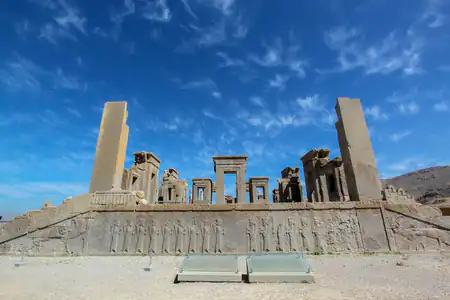
Carved into the staircase at Persepolis, a lion sinks its teeth into a bull. It is not decoration — it is a calendar. Leo rising as Taurus sets marks the spring equinox, when day and night stand in perfect balance. That moment is Nowruz — 'New Day' — the Persian New Year, celebrated without interruption for 2,500 years. Darius the Great (king of the Achaemenid Empire) did not build Persepolis to rule from. He built it to celebrate the rebirth of the world.
The myth goes deeper than the ruins. In the Shahnameh — the soul of Persian literature, written by Ferdowsi (the poet who saved the Persian language) — a king named Jamshid taught humanity everything: weaving, medicine, metalwork. He commanded demons to build a jeweled throne and was carried skyward. When sunlight struck it, light flooded the world, and the people called that day 'New.' For three centuries Jamshid ruled and death was suspended.
Then pride destroyed him. Jamshid declared himself a god. His divine glory fled his body as a falcon. A demon-king named Zahhak rose and sawed him in half. The warning is stitched into the myth: the festival Jamshid created survived, but the king who claimed too much was annihilated. Nowruz belongs to the turning of the earth, not to any crown.
At every equinox, delegations from twenty-three nations climbed the great staircases of Persepolis in national dress — lionesses with cubs, horses, gold dust, ivory. The king received tribute and gave gifts in return. Sacred Zoroastrian fire burned at the heart of the ceremony. Persepolis was not a palace. It was a stage built for a single act: the annual birth of spring.
Twenty-three centuries later, the ruins became a stage again. In 1971, the last Shah of Iran (Mohammad Reza Pahlavi) threw the most extravagant party the modern world had seen — right there among the columns. Fifty air-conditioned luxury tents. Dinner by Maxim's of Paris. Sixty-nine heads of state. The Shah toasted the ghost of Cyrus the Great while much of Iran lived in poverty. Eight years later, a revolution swept him away.
They say you cannot kill what you did not create. Alexander burned Persepolis but could not burn the equinox. The Arab conquest brought Islam but could not suppress a festival woven into daily life. The Mongols leveled cities. The 1979 Islamic Revolution tried to ban Nowruz as un-Islamic — the ayatollahs commanded the mosques, but they could not command the orbit of the earth.
Today, three hundred million people celebrate Nowruz across Iran, Afghanistan, Central Asia, Turkey, Kurdistan, and diaspora worldwide. On the exact second of the equinox, families gather around the Haft-Sin table: seven items beginning with S. Sprouted wheat for rebirth. Garlic for health. Apples for beauty. Vinegar for patience. A mirror reflects light. A goldfish represents life. And a book — the Shahnameh, Hafez, or the Quran — for wisdom.
At Persepolis, the lion still bites the bull in stone. The equinox still comes. And three hundred million people, scattered across the earth by empires and revolutions and exile, still set their tables, still clean their houses, still forgive their enemies, and still declare what Darius carved in stone: the world is new. The world is born again.