
Picture ten thousand soldiers covered in gold. Not metaphorical gold — actual gold bracelets, earrings, and counterweights on their spears. They wore robes of purple and saffron over hidden scale armor. Their bows could kill from 250 meters away. The inner circle — a thousand men called the Apple Bearers — carried spears tipped with golden pomegranates. The rest got silver. These were the Persian Immortals, the most elite fighting force in the ancient world, designed to terrify you before the battle even started.
They got their name from a brilliant trick. Whenever one died — in battle, from disease, anything — his replacement was already waiting. The unit stayed at exactly ten thousand. Always. From across a battlefield, it looked like they couldn't be killed. You'd watch one fall and another appear in his place, like death just didn't apply to them. Some historians think the name was a Greek mix-up — that the Persian word for "companions" sounded like "immortals" to foreign ears. Either way, the name stuck.
Their biggest moment? Thermopylae, 480 BCE — the battle you think you know from the movie 300. Here's what Hollywood left out. When the Persian King Xerxes invaded Greece, seven thousand Greek soldiers blocked a narrow coastal pass called the Hot Gates — barely fifteen meters wide. The Immortals got sent in and beaten back. Not because they were bad soldiers, but because the tight space killed every advantage they had. No room for archery. No way to use their numbers. Just close combat against heavier armor and longer spears.
But the Immortals didn't lose Thermopylae. They won it. A Greek traitor named Ephialtes — whose name means "nightmare" in Greek — told Xerxes about a hidden mountain path behind the Greek lines. Xerxes sent all ten thousand Immortals up that trail at nightfall. They climbed through oak forests in total darkness, slipped past a guard force on the summit, and came down behind the Greeks at dawn. Ten thousand men moving in silence through mountains in the dark — one of the greatest military moves in ancient history.
When the Greeks realized the Immortals were behind them, it was over. King Leonidas of Sparta sent most allies home and made his last stand with three hundred Spartans and about a thousand volunteers. They fought with spears until they broke, then swords, then bare hands. But the outcome was sealed the moment the Immortals completed that march. The West remembers the three hundred who died. It was ten thousand Persians who won the battle — and history barely gives them credit.
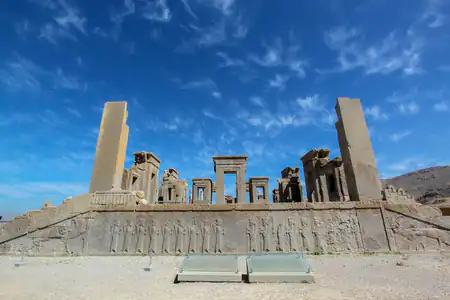
At Persepolis — the ceremonial capital of the Persian Empire in modern-day Iran — the Immortals are carved in stone along massive staircases. Row after row of identical warriors, spears perfectly vertical, stretching the length of entire building walls. The repetition is the point. One soldier is impressive. Ten thousand identical soldiers is a statement. You're not looking at an army. You're looking at a machine.
Today, that carved Immortal guard is one of the most recognized symbols in Iranian culture — on money, stamps, jewelry, and walls of homes worldwide. When the movie 300 turned them into faceless monsters, Iran was furious. Not because of a film, but because the West had spent centuries turning a civilization that built roads from Egypt to India into a cartoon villain. The Immortals weren't a mindless horde. They were proud, gold-wearing warriors who considered it the highest honor to serve their king.