
Three thousand years ago, the most powerful man on Earth fell completely in love — and he didn’t just write about it. He carved it into a mountain. Ramesses II, pharaoh of Egypt, had dozens of wives. Pharaohs collected queens the way modern leaders collect allies — they were political tools, not partners. But one woman changed everything. Her name was Nefertari, and Ramesses loved her in a way that still leaves historians stunned.
Nefertari married Ramesses when he was still just a prince — before the crown, before the power. And when he became pharaoh, he didn’t push her aside. He pulled her closer. She stood next to him at state ceremonies. She wrote letters directly to foreign queens, including Puduhepa, queen of the Hittite Empire — Egypt’s greatest rival at the time. She performed religious rituals normally reserved for the pharaoh alone. Her official titles say it all: “Sweet of Love,” “Lady of All Lands.”
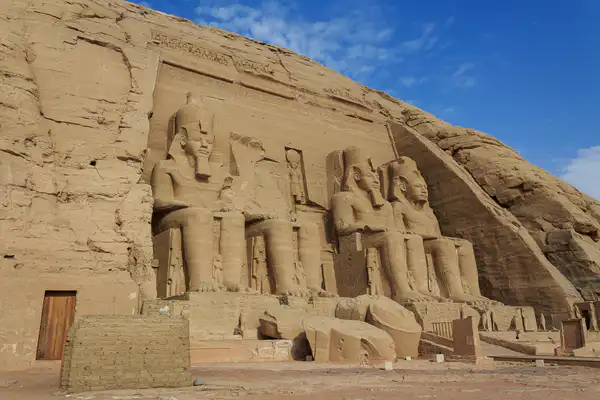
At Abu Simbel, deep in what is now southern Egypt, Ramesses built Nefertari her own temple — carved straight into a cliff face. This was almost unheard of. Pharaohs built temples for gods, not for wives. But here’s the detail that stops you cold: on the front of that temple, Nefertari’s statues are the exact same size as Ramesses’. In Egyptian art, size equaled power. Making her his equal in stone was like rewriting the rules of an entire civilization.
Above the entrance, Ramesses left an inscription that has survived over three thousand years. He built this temple for “the Great Royal Wife Nefertari — she for whom the sun shines.” And that wasn’t just poetry. The Abu Simbel temples were designed with precise solar alignments — built so the sun would reach deep into the rock on specific days of the year. “She for whom the sun shines” was a love letter and an engineering blueprint at the same time. He literally aimed the sun at her.
When Nefertari died — she was around forty, about twenty-four years into Ramesses’ reign — he gave her the most breathtaking burial in Egyptian history. Her tomb, known as QV66 in the Valley of the Queens, is covered wall to wall with paintings so stunning that scholars call it the “Sistine Chapel of ancient Egypt.” Goddesses take Nefertari by the hand, guiding her into the afterlife. She moves through those painted walls like she belongs among the gods — because in Ramesses’ world, she did.
On those tomb walls, Ramesses left what might be the oldest love letter still standing: “My love is unique — no one can rival her. She is the most beautiful woman alive. Just by passing, she has stolen away my heart.” That’s the most powerful man in the ancient world, talking about his wife like a lovesick teenager. And 3,200 years later, you can still read every word.
Ramesses lived to about ninety. He ruled for over forty more years after she died. He married other queens, fathered over a hundred children, and built monuments across an empire stretching from modern-day Sudan to Syria. But the thing people remember? It’s not the battles or the conquests. It’s a temple he carved into a cliff in the middle of nowhere, for a woman he never got over. Some love stories last a lifetime. This one has lasted thirty-two centuries — and counting.