
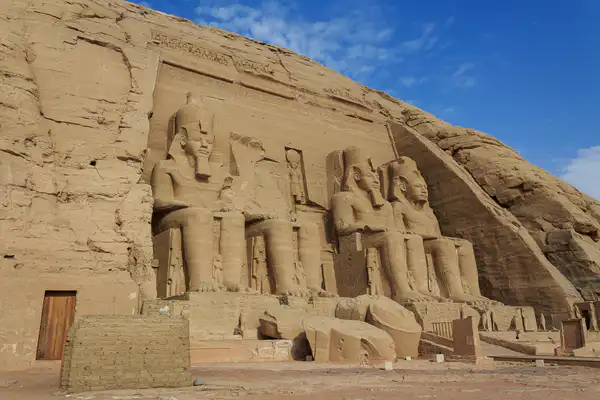
Twice a year, something happens at Abu Simbel in southern Egypt that shouldn’t be possible. At sunrise on February 22 and October 22, a beam of sunlight enters the temple’s eastern doorway and travels straight through 60 meters of solid rock — through halls, corridors, and chambers — until it reaches the darkest room in the structure. The innermost sanctuary. And there, it lights up the faces of three stone gods who’ve been sitting in total darkness for the other 363 days of the year.
The light hits three figures: Amun-Ra, king of the gods. Ra-Horakhty, god of the rising sun. And Ramesses II himself — the pharaoh who built this place and had the nerve to seat his own statue among the divine. For about twenty minutes, all three glow in golden light while the fourth statue — Ptah, god of darkness and the underworld — stays completely in shadow. That’s not a coincidence. That’s the whole point. Even the sun knows who belongs in the light and who belongs in the dark.
Here’s what makes this truly wild. The builders of Abu Simbel pulled this off around 1244 BC — more than three thousand years ago. No telescopes. No computers. No GPS. They calculated exactly where the sun would rise on two specific days of the year, figured out the precise angle, and carved an entire temple into a cliff face so that a shaft of light would thread through 60 meters of rock and land on exactly the right spot. They had one shot. You can’t reposition a mountain.
Those two dates — February 22 and October 22 — are traditionally believed to mark Ramesses II’s birthday and the anniversary of his coronation. Historians debate this, but honestly, the argument misses the point. Whether it’s his birthday or not, someone designed a building that makes the sun itself pay tribute to one man on a schedule. And it’s been doing it, faithfully, for over three thousand years. That’s a level of ambition no modern architect has come close to matching.
Every year, thousands of people gather at Abu Simbel before dawn, waiting. And when it happens — when that first sliver of light creeps through the doorway and crawls sixty meters through the stone until three ancient faces suddenly blaze gold in the blackness — it doesn’t feel like astronomy. It feels sacred. For the ancient Egyptians, that was exactly the idea: the sun god Ra himself, walking through the door to visit the pharaoh who sat among the gods.
In the 1960s, Egypt’s new Aswan High Dam threatened to drown Abu Simbel under a rising reservoir. So UNESCO launched one of the boldest rescue missions in history: they cut the entire temple into 1,036 blocks, lifted everything 65 meters up a cliff, and pieced it back together on higher ground. One of their biggest challenges? Keeping an astronomical alignment that ancient engineers had set more than three thousand years earlier.
They pulled it off — almost. After the move, the light now arrives one day late, hitting the sanctuary on February 21 and October 21 instead. That one-day gap might be the most telling detail of the whole story. A modern team with every tool imaginable moved an entire mountain temple and missed by twenty-four hours. The original builders, working with nothing but their eyes, their math, and their faith, nailed it on the first try. Three thousand years later, the sun still shows up on time.