
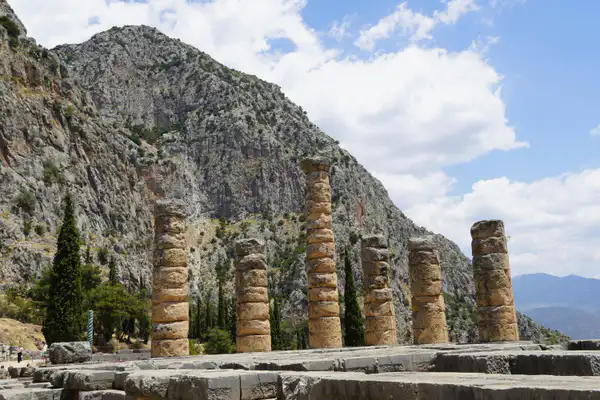
Picture this: it's the 6th century BCE, ancient Greece. You've walked for days to reach Delphi — the most sacred place in the Greek world. Here stands the temple of Apollo, god of light and prophecy. Inside sits a priestess called the Pythia, believed to speak with the voice of the god himself. You've come with a question that could change your life. But before you step through the entrance, you look up — and there, carved into the stone, are two words: Γνῶθι Σεαυτόν — "Know Thyself."
Nobody knows exactly who wrote those words. The Greeks credited them to the Seven Sages — a legendary group of thinkers and statesmen from the 6th century BCE. The names you hear most are Thales of Miletus and Chilon of Sparta. Next to the inscription was a second saying, just as powerful: "Nothing in Excess" (Μηδὲν Ἄγαν). Two sentences, side by side, guarding the door to the most important oracle in the ancient world.
But what does "know thyself" actually mean? The Greeks understood it on several levels. The first was a blunt warning: you are not a god. You came here to ask about wars and the fate of empires, and the very first thing the temple tells you is — remember that you're mortal. You have limits. Don't forget your place in the order of things.
The second level was practical advice: understand your own nature — your strengths and your blind spots, your desires and your fears. There's an old saying, "physician, heal thyself," and the Greeks meant something similar. A person who doesn't know themselves is a slave to their own impulses without even realizing it. You can't fix what you can't see.
The third level was the deepest: the ultimate truth isn't out there in the world — it's inside you. To know yourself is to touch something sacred, a spark that connects you to the larger order of the universe. Centuries later, Socrates would distill this idea into one of the most quoted lines in history: "The unexamined life is not worth living."
And here's the twist with Socrates. When the Oracle at Delphi declared that no man was wiser than him, Socrates was baffled. He was sure he knew almost nothing. But after thinking it over, he realized that was exactly the point. His wisdom wasn't in what he knew — it was in knowing what he didn't know. Everyone else walked around believing they had answers they didn't actually have. Socrates, at least, was honest about his own ignorance.
The second maxim, "Nothing in Excess," completed the first. Greek culture valued balance above almost everything. Too much courage becomes recklessness. Too much caution becomes cowardice. Real virtue always sits in the narrow space between too much and too little — and the only way to find that middle ground is to know yourself well enough to recognize when you're drifting.
More than two and a half thousand years have passed, and those two sentences carved in stone are still the starting point for anyone searching for wisdom. Before you understand the world, understand yourself. Before you act, know your limits. The Oracle spoke in riddles, but the answer to every riddle starts in the same place — knowing who you are.