
About
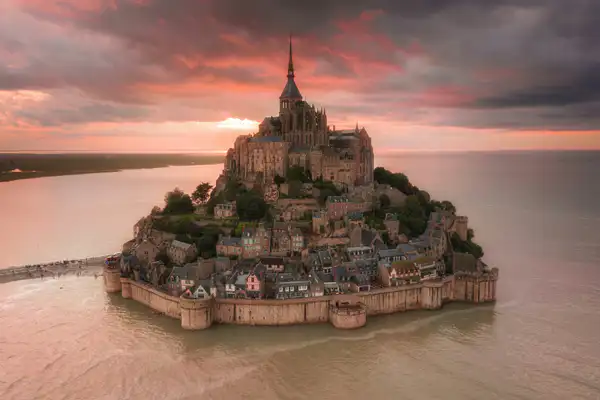
Mont Saint-Michel is a tidal island commune in Normandy, crowned by a breathtaking Gothic-Romanesque abbey that rises like a vision from the sea — one of the most recognizable and spiritually charged landmarks in all of Western civilization. Called "La Merveille de l'Occident" (The Wonder of the Western World) since the Middle Ages, the island rises 92 meters above the treacherous tidal flats of the bay, its silhouette dominated by the soaring abbey church and the gilded statue of the Archangel Michael slaying the dragon atop its 156-meter spire. Founded in 708 AD when Bishop Aubert of Avranches received a divine command from the Archangel Michael to build a church on the rocky islet then called Mont-Tombe, the site evolved over eight centuries from a simple oratory into one of the most ambitious architectural achievements of the Middle Ages. The abbey complex is a masterpiece of medieval engineering — a vertical city built on a granite pinnacle, with buildings stacked upon buildings, supported by massive crypts and buttresses that seem to defy gravity. During the Hundred Years' War, Mont Saint-Michel became the only place in northern France that was never captured by the English, its tiny garrison of 119 knights holding out for over 30 years against repeated sieges and blockades. This miraculous resistance made the Mont a symbol of French national identity and divine protection. The bay itself served as a natural defense — its tides, among the highest in Europe at up to 15 meters, could sweep in "as fast as a galloping horse" according to Victor Hugo, swallowing unwary pilgrims in quicksand and cutting off besieging armies. Today, Mont Saint-Michel and its bay are a UNESCO World Heritage Site, receiving over 3 million visitors annually. The recent removal of the causeway and its replacement with a pedestrian bridge has begun to restore the island's maritime character, allowing the sea to once again encircle this eternal monument to faith, courage, and architectural genius.
Historical Significance
“Mont Saint-Michel represents one of the supreme achievements of medieval Western architecture and one of the most important pilgrimage sites in Christendom. The abbey is a masterwork of Romanesque and Gothic architecture built under extraordinary constraints — perched on a granite rock in a bay with some of the most extreme tides in Europe. The site's significance is multi-layered. Architecturally, "La Merveille" (the Marvel), the Gothic section built between 1211 and 1228, is considered one of the finest examples of 13th-century architecture, with its three-story complex of the Almoner's Hall, Guest Hall, Knights' Hall, Refectory, and Cloister stacked vertically on the north face of the rock. The engineering required to build this on a sloping granite pinnacle was so advanced that contemporaries attributed it to divine intervention. Militarily, Mont Saint-Michel's successful resistance during the Hundred Years' War (1337-1453) made it a powerful symbol of French resilience. The garrison that held the Mont when all of Normandy had fallen to the English became legendary, and the site's defense directly inspired Joan of Arc, who heard the voice of the Archangel Michael commanding her to save France. Spiritually, the Mont was one of the three great medieval pilgrimage destinations (along with Rome and Santiago de Compostela). The perilous crossing of the bay — where tides could kill the unwary — became a metaphor for the spiritual journey, a crossing from the profane world to the sacred. Pilgrims who survived the crossing and climbed to the abbey felt they had truly earned their salvation.”
داستانها
1History
👑 Built by
Bishop Aubert of Avranches (founded 708 AD)
708 - Bishop Aubert of Avranches builds first oratory after vision of Archangel Michael
966 - Benedictine monks establish the abbey under Duke Richard I of Normandy
1017-1144 - Romanesque abbey church constructed
1204 - Breton allies of Philip Augustus set fire to the town; abbey partially destroyed
1211-1228 - "La Merveille" (The Marvel) Gothic complex built — masterpiece of medieval architecture
1337-1453 - Hundred Years' War: Mont Saint-Michel never falls to the English despite 30+ years of siege
1421 - Romanesque choir collapses; rebuilt in Flamboyant Gothic style (completed 1521)
1469 - Louis XI establishes the Order of Saint Michael at the abbey
1622 - Benedictine reform by the Congregation of Saint-Maur
1790 - French Revolution: monks expelled, abbey becomes a prison ("Bastille of the Seas")
1874 - Classified as a historic monument; restoration begins
1897 - Gilded statue of Archangel Michael placed atop the spire
1979 - Inscribed as UNESCO World Heritage Site
2014 - New pedestrian bridge replaces the causeway, restoring the island's maritime character