
About
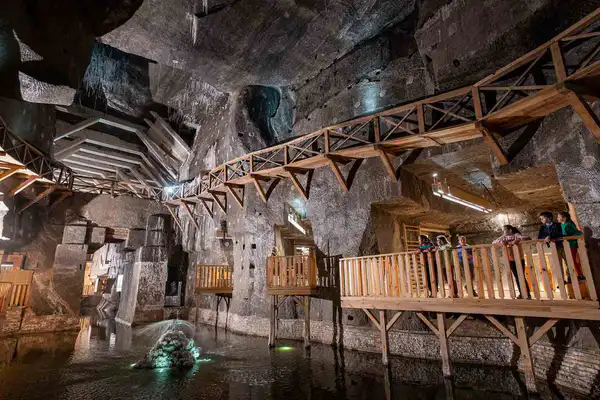
The Wieliczka Salt Mine, located just fourteen kilometers southeast of Kraków, is one of the oldest continuously operating salt mines in the world and one of the most extraordinary underground monuments ever created by human hands. Mining began here as early as the Neolithic period, when surface brine pools were evaporated for salt, but organized underground extraction commenced in the thirteenth century under the Polish Crown, and the mine has been in continuous operation for over seven hundred years — making it one of the longest-running commercial enterprises in human history. What distinguishes Wieliczka from every other mine on earth is not its scale — though that is immense, with over 245 kilometers of tunnels spread across nine levels reaching a depth of 327 meters — but what its miners created within those tunnels across the centuries. Working in the eerie silence of the deep earth, generations of miners carved the salt itself into an underground world of staggering beauty and ambition. Chapels, altarpieces, chandeliers, staircases, statues, and entire cathedral-sized chambers were sculpted from the living rock salt, transforming a place of hard industrial labor into a subterranean gallery of folk art, religious devotion, and architectural wonder. The most celebrated of these creations is the Chapel of St. Kinga (Kaplica św. Kingi), located 101 meters below the surface. This vast underground cathedral — 54 meters long, 18 meters wide, and 12 meters high — was carved entirely from salt by three miners over a period of sixty-seven years, from 1896 to 1963. Every element is salt: the floor tiles, the altar, the bas-relief sculptures depicting scenes from the life of Christ, the ornate wall carvings, and the extraordinary chandeliers, each containing between twenty and thirty thousand individual salt crystals that catch and scatter the light into a thousand translucent facets. The chapel is still consecrated and hosts weddings, concerts, and religious services in an atmosphere of otherworldly beauty. The mine also contains underground lakes of crystalline salt water, vast chambers supported by timber structures dating back centuries, and a sanatorium established in the nineteenth century for the treatment of respiratory ailments — the unique microclimate of the salt mine, with its stable temperature, high humidity, and salt-particle-laden air, having been recognized early on for its therapeutic properties. Wieliczka was inscribed on the inaugural UNESCO World Heritage List in 1978, one of only twelve sites worldwide to receive this distinction in the program's first year. It receives over 1.7 million visitors annually, making it the most-visited tourist attraction in Poland. The mine stands as a testament to the ingenuity, artistry, and endurance of the miners who, over seven centuries, transformed a place of darkness and danger into an underground palace of salt and light.
Historical Significance
“Wieliczka Salt Mine represents one of the most remarkable intersections of industry, art, and spirituality in European history. For seven centuries, miners descended into the earth to extract the "white gold" that was one of the Polish Crown's most valuable commodities — salt was so precious that the word "salary" derives from the Latin salarium, the salt ration paid to Roman soldiers. The revenues from Wieliczka and its sister mine at Bochnia financed kingdoms, funded universities, and built the splendor of medieval Kraków. But Wieliczka's true significance lies in what the miners created underground. Working in conditions of extreme difficulty — darkness, damp, the ever-present danger of collapse or flooding — they devoted their limited free time to carving religious chapels, sculptures, and ornamental chambers from the very salt they mined. This was not commissioned court art but an authentic expression of working-class devotion, folk creativity, and the human need to create beauty even in the harshest environments. The Chapel of St. Kinga is the supreme achievement of this tradition: a cathedral-scale space carved over sixty-seven years by men who descended into the earth each day knowing they might not return, yet who spent their lives transforming that darkness into light. UNESCO recognized Wieliczka in 1978 as one of the original twelve World Heritage Sites, alongside the Galápagos Islands, Yellowstone, and the Historic Centre of Kraków — placing this salt mine among the most important cultural treasures on Earth.”
Stories
1History
👑 Built by
Polish Crown miners across seven centuries; Chapel of St. Kinga carved by Józef Markowski, Antoni Wyrodek, and their successors (1896-1963)
1044 - First documented salt extraction from brine pools at Wieliczka
1252 - Duke Bolesław V "the Chaste" grants mining privileges; organized underground extraction begins
1290 - Wieliczka granted town charter by King Wenceslaus II of Bohemia
1368 - King Casimir III the Great issues the Statut Żup, codifying mining law at Wieliczka
1697 - King Augustus II the Strong entertains 300 guests at an underground banquet 130 meters below ground
1774 - Austrian Partition; mine passes to Habsburg control until 1918
1896-1963 - Carving of the Chapel of St. Kinga over 67 years by three successive miners
1927 - Underground sanatorium established for respiratory therapy
1978 - Inscribed on the inaugural UNESCO World Heritage List
1996 - Commercial salt mining officially ends; mine transitions fully to tourism and culture
2010 - Named a Historic Monument of Poland by presidential decree