
About
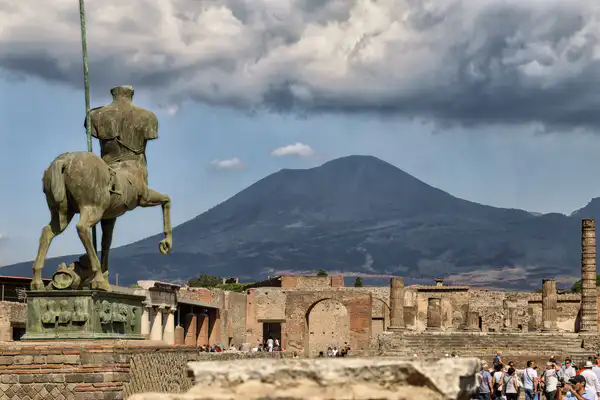
s citizens in heartbreaking detail: a mother sheltering her child, a dog straining against its chain, a man covering his mouth against the toxic gases. These casts transformed Pompeii from a collection of ancient buildings into a memorial to individual human lives lost in catastrophe. Today, approximately 44 of the site's 66 hectares have been excavated, meaning that roughly a third of the city still lies buried and awaiting discovery. Ongoing excavations continue to yield spectacular finds, including the recent discovery of an intact ceremonial chariot in 2021 and a thermopolium (ancient fast-food counter) with food still preserved in its terracotta vessels. Pompeii is not merely a relic of the past but an active archaeological frontier, a city that continues to reveal its secrets nearly three centuries after its rediscovery.
Historical Significance
“Pompeii is the single most important archaeological site for understanding daily life in the ancient Roman world. Unlike monumental sites such as the Roman Forum or the Colosseum, which showcase imperial grandeur, Pompeii preserves the complete texture of an ordinary provincial city: its homes, shops, workshops, temples, brothels, baths, taverns, gardens, and street life. The volcanic preservation was so complete that even organic materials — wooden furniture, food, textiles, papyrus scrolls — survived in carbonized form, providing evidence that would have been lost at any conventionally abandoned site. The site revolutionized the field of archaeology itself. When systematic excavations began under Karl Weber in 1748 for King Charles III of Naples, the prevailing approach to ancient remains was essentially treasure hunting — removing beautiful objects for royal collections. Pompeii's sheer scale and completeness demanded a different approach. Giuseppe Fiorelli, who took charge of excavations in 1860, introduced stratigraphic methods, systematic documentation, and the revolutionary plaster casting technique that captured the city's dead in their final moments. His methods became foundational to modern archaeological practice worldwide. Pompeii was inscribed as a UNESCO World Heritage Site in 1997, recognized as providing an outstanding and comprehensive picture of Roman society and daily life at a specific moment in history. The site receives approximately 4 million visitors annually, making it one of Italy's most visited cultural attractions and one of the most important archaeological destinations in the world.”
Истории
3History
👑 Built by
Oscan settlers, later expanded by Samnites, Greeks, and Romans
c. 7th-6th century BC - Oscan settlement established on volcanic ridge
5th century BC - Samnite conquest; city expanded with Hellenistic influence
310 BC - Roman alliance established
89 BC - Siege by Roman general Sulla during the Social War
80 BC - Becomes Roman colony as Colonia Cornelia Veneria Pompeianorum
62 AD - Major earthquake severely damages the city; rebuilding underway
August 24, 79 AD - Eruption of Vesuvius buries Pompeii under 4-6 meters of ash and pumice
1599 - Architect Domenico Fontana accidentally discovers ruins during canal construction
1748 - Systematic excavation begins under Karl Weber for King Charles III of Naples
1860-1875 - Giuseppe Fiorelli revolutionizes excavation methods; invents plaster casting technique (1863)
1943 - Allied bombing damages parts of the site during World War II
1997 - Inscribed as UNESCO World Heritage Site
2018 - Regio V excavations begin, yielding major new discoveries
2021 - Intact ceremonial chariot discovered in the Villa of Civita Giuliana