
About
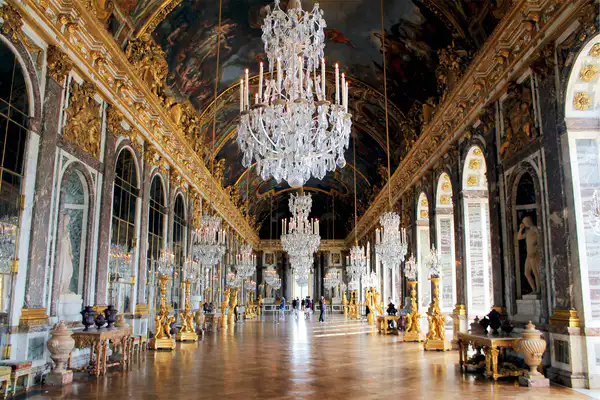
The Palace of Versailles is the supreme expression of absolute monarchy and the most opulent royal residence ever built — a monument to the ambition, vanity, and artistic vision of Louis XIV, the Sun King, who transformed his father's modest hunting lodge into a palace of 2,300 rooms, 67 staircases, and 1,400 fountains set within 800 hectares of manicured gardens. Versailles is not merely a building; it is a political statement carved in marble and gilded in gold, designed to make every person who entered it feel the overwhelming power of the French crown. The palace's construction consumed the wealth of France for over fifty years (1661-1715), employing 36,000 workers at its peak and costing the equivalent of billions in today's currency. Louis XIV moved his court here in 1682, forcing the entire French nobility to live under his gaze — a brilliant political strategy that transformed potentially dangerous feudal lords into decorative courtiers competing for the honor of handing the king his shirt. The Hall of Mirrors — 73 meters long, illuminated by 357 mirrors and 20,000 candles — became the most famous room in the world, the setting for the treaty that ended World War I and countless moments of historical grandeur. The gardens, designed by André Le Nôtre, represent the ultimate triumph of human reason over nature — geometry imposed on the landscape as far as the eye can see. But Versailles is also a place of ghosts. Marie Antoinette's Petit Trianon, where the doomed queen played at being a simple shepherdess, has been the setting for one of the most famous ghost encounters in history. And the palace itself was the pressure cooker in which the French Revolution was born — the disparity between the gold-encrusted halls and the starving peasants outside its gates eventually ignited the conflagration that would consume the monarchy itself.
Historical Significance
“Versailles represents the apotheosis of European absolutism and remains the most influential palace in Western architectural history. Every European monarch attempted to build their own Versailles — from the Schönbrunn in Vienna to the Peterhof in St. Petersburg — but none could match the original's scale, ambition, or political genius. The palace served as the seat of French government from 1682 until the Revolution in 1789, during which time it was the de facto capital of Europe. The decisions made within its walls shaped the continent's politics, wars, art, and culture for over a century. The Treaty of Versailles, signed in the Hall of Mirrors in 1919, ended World War I and redrew the map of Europe — a deliberate choice of location designed to humiliate Germany in the very room that celebrated French glory. Architecturally, Versailles established the template for the grand palace: the enfilade of state rooms, the formal garden, the orangerie, the grand canal. Its decorative program — overseen by Charles Le Brun — created a mythological universe in which Louis XIV was equated with Apollo, the sun god, and every ceiling painting, fountain sculpture, and gilded ornament reinforced this divine-right narrative. The social system of Versailles was itself a masterpiece of political engineering. By requiring the nobility to attend court, Louis XIV effectively neutralized the feudal aristocracy that had plagued his predecessors with rebellions. The elaborate etiquette — who could sit in the king's presence, who could watch him dress, who held the candlestick at bedtime — turned power into ritual and rebellion into bad manners.”
Истории
2History
👑 Built by
Louis XIV (the Sun King), architects Louis Le Vau, Jules Hardouin-Mansart, and André Le Nôtre (gardens)
1623 - Louis XIII builds a modest hunting lodge at Versailles
1661 - Louis XIV begins transformation into a palace after the Vaux-le-Vicomte incident
1668-1670 - First major expansion: "Envelope" wraps new buildings around the old lodge
1678-1684 - Hall of Mirrors constructed by Jules Hardouin-Mansart and Charles Le Brun
1682 - Louis XIV moves the royal court and government to Versailles
1715 - Death of Louis XIV after 72-year reign; court briefly returns to Paris
1722 - Louis XV returns the court to Versailles
1770 - Marriage of future Louis XVI and Marie Antoinette at the Royal Chapel
1783 - Treaty of Paris signed at Versailles, recognizing American independence
1789 - October: Revolutionary mob marches from Paris and forces royal family back to Paris
1837 - Louis-Philippe converts palace into Museum of the History of France
1871 - German Empire proclaimed in the Hall of Mirrors after Franco-Prussian War
1919 - Treaty of Versailles signed in Hall of Mirrors, ending World War I
1979 - Inscribed as UNESCO World Heritage Site