
About
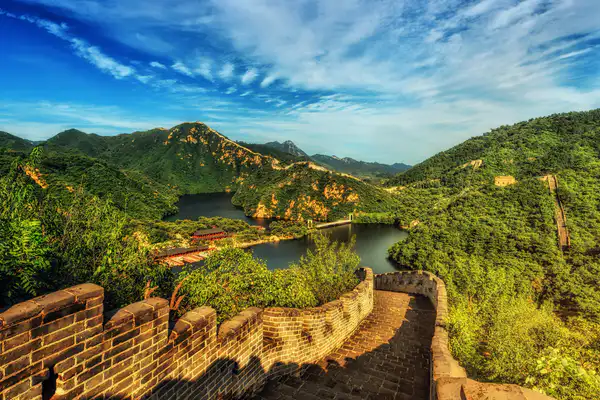
The Great Wall of China is the single largest construction project in human history — a colossal network of walls, watchtowers, garrison stations, and signal beacons stretching over 21,196 kilometers across northern China. Built and rebuilt by successive dynasties over two millennia, it stands as humanity's most ambitious attempt to defy geography, time, and the endless tide of invasion from the northern steppes. The wall that most visitors see today dates from the Ming Dynasty (1368-1644), when Emperor Zhu Yuanzhang and his successors rebuilt and fortified the frontier after expelling the Mongol Yuan Dynasty. But the wall's origins reach back to the 7th century BC, when the states of Chu, Qi, and Yan built separate defensive barriers. In 221 BC, after unifying China, Qin Shi Huang — the First Emperor — conscripted hundreds of thousands of laborers to connect and extend these walls into a single defensive system. The human cost was staggering. Ancient sources estimate that between 400,000 and one million workers died during the Qin Dynasty construction alone, their bodies supposedly buried within the wall itself. Chinese folklore calls it "the longest cemetery on Earth." The wall traverses 15 provinces and autonomous regions, crossing deserts, grasslands, mountains, and plateaus. At its most dramatic sections — Badaling, Mutianyu, Jinshanling, and Simatai near Beijing — it undulates over jagged mountain ridges like the spine of a dragon, a metaphor that has persisted in Chinese culture for millennia. UNESCO inscribed the Great Wall as a World Heritage Site in 1987, and it was voted one of the New Seven Wonders of the World in 2007. It remains the most potent symbol of Chinese civilization — a testament to the nation's determination, sacrifice, and enduring will to survive.
Historical Significance
“The Great Wall is not merely a military fortification — it is the physical embodiment of Chinese civilization's central anxiety: the existential tension between the settled agricultural world of the Central Plains and the nomadic warrior cultures of the northern steppes. For over two thousand years, China's greatest minds — strategists, emperors, engineers — grappled with this fundamental problem. The wall was their answer: a line drawn in stone and brick between civilization and chaos, between "us" and "them," between the Celestial Empire and the barbarian wilderness beyond. The wall's military effectiveness was debatable — it was breached multiple times by Mongols, Jurchens, and Manchus. But its symbolic power was absolute. It defined the boundary of Chinese identity itself. To be "within the wall" (关内) was to be Chinese; to be "beyond the wall" (关外) was to be other. The Ming Dynasty walls represent the pinnacle of wall-building technology, with double-faced brick construction, interior drainage systems, and sophisticated signal tower networks capable of transmitting messages across 500 kilometers in a single day using smoke and fire signals. The wall's cultural significance extends far beyond military history. It appears in Chinese poetry, painting, philosophy, and political discourse across every dynasty. Mao Zedong wrote: "He who has not climbed the Great Wall is not a true man" — a phrase that has become a national motto.”
Récits
3History
👑 Built by
Multiple dynasties: Qin Shi Huang (unified, 221 BC), Han, Sui, Jin, and Ming Dynasty (current walls, 1368-1644)
~7th century BC - States of Chu, Qi, and Yan build separate defensive walls during the Warring States period
221 BC - Qin Shi Huang orders General Meng Tian to connect and extend existing walls; hundreds of thousands conscripted
~210 BC - Qin Shi Huang dies; wall construction continues under subsequent dynasties
130-101 BC - Han Dynasty extends the wall westward along the Silk Road to Dunhuang and beyond
607 AD - Sui Dynasty Emperor Yang rebuilds sections using over one million laborers
1211-1234 - Genghis Khan and Mongol armies breach the wall, eventually conquering all of China (Yuan Dynasty)
1368 - Ming Dynasty founded; systematic reconstruction of the wall begins after expelling the Mongols
1449 - Emperor Yingzong captured by Mongols at Tumu Crisis; wall construction intensifies
1568-1583 - General Qi Jiguang transforms the wall into the brick-and-stone structure visible today at Badaling and Mutianyu
1644 - General Wu Sangui opens the Shanhaiguan gate to Manchu forces, ending the Ming Dynasty — the wall breached from within
1987 - Inscribed as UNESCO World Heritage Site
2007 - Voted one of the New Seven Wonders of the World
2012 - Chinese government survey reveals the wall's total length is 21,196.18 km