
About
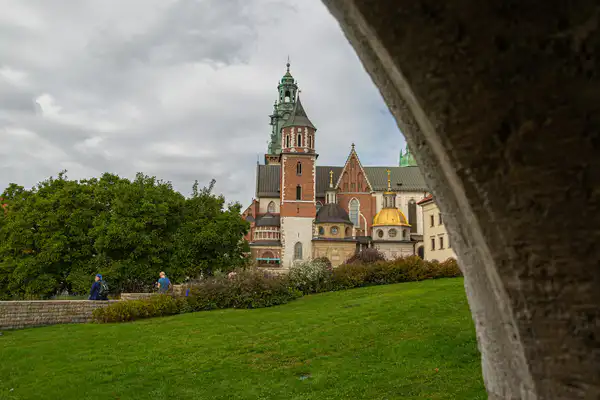
Wawel Castle stands atop a limestone hill overlooking the Vistula River in the heart of Kraków, and for over five centuries it served as the seat of Polish kings, the spiritual center of the nation, and one of the most magnificent royal residences in Central Europe. The hill itself has been inhabited since at least the Paleolithic era, and archaeological excavations have revealed traces of continuous settlement stretching back some fifty thousand years, making Wawel one of the oldest continuously occupied sites on the continent. The castle complex as it exists today is primarily the product of a massive Renaissance transformation carried out under King Sigismund I "the Old" between 1507 and 1536, when the Italian architects Francesco Fiorentino and Bartolomeo Berecci reshaped the medieval fortress into one of the finest examples of Renaissance palatial architecture outside Italy. The arcaded courtyard, with its three tiers of graceful loggia supported by slender columns, became the architectural heart of the new palace and remains one of the most photographed spaces in Poland. Yet beneath and around this Renaissance shell, elements of the earlier Romanesque and Gothic structures survive, creating a layered palimpsest of Polish architectural history. The Wawel Cathedral, formally the Cathedral Basilica of Saints Stanislaus and Wenceslaus, stands adjacent to the castle and has served as the coronation site for Polish monarchs since 1320 and as the royal necropolis for centuries. Within its walls and crypts lie the remains of kings, queens, national heroes, and poets — including Tadeusz Kościuszko, Józef Piłsudski, and the medieval king Casimir III the Great. The cathedral is an architectural anthology in itself: its Gothic nave is surrounded by eighteen chapels spanning Romanesque, Gothic, Renaissance, and Baroque styles, the most celebrated being the Sigismund Chapel (Kaplica Zygmuntowska), which the art historian Szymon Starowolski called "the most beautiful example of the Tuscan Renaissance north of the Alps." The Wawel complex also houses extraordinary collections: the Crown Treasury and Armoury display the coronation sword Szczerbiec, used in every Polish coronation from 1320 to 1764; the State Rooms contain the magnificent collection of 142 Flemish tapestries commissioned by King Sigismund II Augustus, one of the finest Renaissance textile collections in the world; and the cathedral treasury holds relics, vestments, and liturgical objects spanning a millennium of Polish Christianity. Inscribed as part of Kraków's Historic Centre on the UNESCO World Heritage List in 1978 — one of the first sites in the world to receive this designation — Wawel Hill remains the symbolic heart of the Polish nation, a place where history, spirituality, art, and national identity converge with a density and emotional power matched by few sites anywhere in Europe.
Historical Significance
“Wawel Castle is the supreme symbol of Polish statehood, sovereignty, and cultural identity. For over five hundred years it served as the seat of the Polish monarchy, and even after the capital moved to Warsaw in 1596, Wawel retained its status as the coronation site and royal necropolis. During the long centuries of foreign partition (1795-1918), when Poland was erased from the map of Europe, Wawel became a sacred pilgrimage site for Poles who came to pray at the tombs of their kings and draw inspiration from the memory of national independence. The castle's architectural significance is equally profound. The Renaissance courtyard, designed by Italian masters working for Sigismund I, brought the artistic revolution of the Italian Renaissance directly into the heart of Central Europe. The Sigismund Chapel, completed in 1533, is considered the single most important piece of Italian Renaissance architecture outside Italy. The Flemish tapestry collection, the Crown Treasury, and the cathedral's artistic wealth make Wawel one of the most important museum complexes in Europe. UNESCO inscribed Kraków's Historic Centre, with Wawel at its heart, in 1978 as one of the twelve inaugural World Heritage Sites.”
Hikâyeler
1History
👑 Built by
Multiple builders across centuries; Renaissance transformation by King Sigismund I (architects Francesco Fiorentino and Bartolomeo Berecci, 1507-1536)
~11th century - First stone fortifications built on Wawel Hill under the Piast dynasty
1020 - Wawel Cathedral consecrated as the seat of the Kraków bishopric
1138 - Kraków becomes the capital of the Seniorate Province, elevating Wawel's status
1320 - First coronation held in Wawel Cathedral (Władysław I the Elbow-High)
1364 - King Casimir III the Great founds the University of Kraków (Jagiellonian University)
1499 - Fire destroys much of the Gothic castle, prompting the Renaissance rebuilding
1507-1536 - King Sigismund I commissions Italian architects to create the Renaissance palace
1533 - Sigismund Chapel completed, called "the pearl of the Renaissance north of the Alps"
1596 - King Sigismund III Vasa moves the capital to Warsaw; Wawel retains ceremonial role
1655 - Swedish invasion ("the Deluge") causes significant damage and looting
1795-1918 - Austria controls Wawel during the Partitions of Poland; used as military barracks
1905 - Austrian army vacates Wawel; restoration begins
1978 - UNESCO World Heritage Site inscription as part of Kraków's Historic Centre