
About
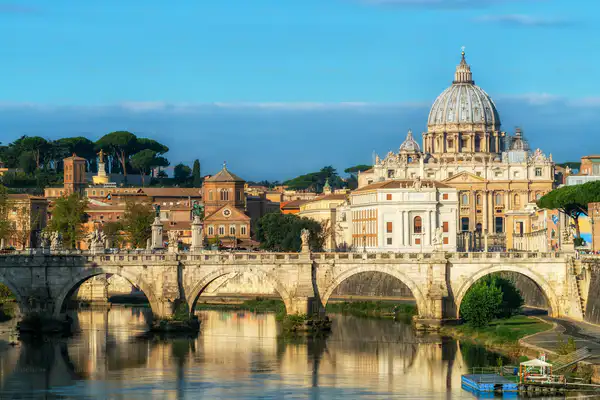
St. Peter's Basilica is the largest church in the world and the spiritual heart of Roman Catholicism, rising above the spot where the apostle Peter was believed to have been buried after his crucifixion in Nero's Circus around 64 AD. The present basilica, which replaced the crumbling fourth-century Constantinian original, took 120 years to build and consumed the talents of the greatest architects and artists the Renaissance and Baroque periods ever produced. Donato Bramante laid the first stone in 1506 with a radical Greek-cross plan; Raphael succeeded him and shifted toward a Latin cross; Antonio da Sangallo the Younger expanded the design further; and then Michelangelo, at seventy-one years old, took command and designed the soaring dome that defines the Roman skyline to this day. Carlo Maderno extended the nave and built the imposing travertine facade, and Gian Lorenzo Bernini crowned the interior with his theatrical bronze baldachin and the radiant Cathedra Petri, the throne of St. Peter encased in gilded glory. Adjacent to the basilica, the Sistine Chapel houses what many consider the supreme achievement of Western art: Michelangelo's ceiling frescoes painted between 1508 and 1512, and his monumental Last Judgment on the altar wall completed in 1541. Over 300 figures sprawl across more than 500 square meters of ceiling, depicting scenes from Genesis with an anatomical precision and emotional intensity that had never been attempted before and have never been equaled since. The chapel serves as the site where the College of Cardinals gathers in conclave to elect each new pope, making it one of the most consequential rooms on Earth. Beyond the basilica and chapel, the Vatican Museums contain one of the most extraordinary collections of art and antiquities ever assembled, accumulated over five centuries by successive popes. The collection includes the Raphael Rooms, the Gallery of Maps, the Laocooen and His Sons sculpture, and thousands of masterworks spanning Egyptian, Greek, Roman, and Renaissance art. Together with Bernini's magnificent St. Peter's Square — an elliptical colonnade of 284 Doric columns and 88 pilasters arranged in four rows, topped by 140 statues of saints — the Vatican complex forms a pilgrimage destination that draws over six million visitors each year and remains the administrative and ceremonial center of a faith practiced by 1.3 billion people worldwide. Within the basilica itself, Michelangelo's Pieta — carved when the artist was just twenty-four — depicts the Virgin Mary cradling the body of Christ with a tenderness and technical mastery that left Rome speechless in 1499 and continues to stop visitors in their tracks today. It is the only work Michelangelo ever signed, having overheard someone attribute it to another sculptor. The Vatican stands not merely as a church or a museum but as a living chronicle of two millennia of faith, power, artistic genius, and the human aspiration toward the transcendent.
Historical Significance
“...s Basilica is the most important church in Christendom — not the cathedral of Rome (that honor belongs to the Lateran Basilica), but the symbolic center of the Catholic world and the papal seat of power. It is built upon a site of unbroken sacred significance stretching back to the first century, when the apostle Peter was reportedly crucified upside down in Nero's Circus and buried in a nearby cemetery. The basilica's construction triggered one of the most consequential events in Western history. To finance the building, Pope Leo X authorized the sale of indulgences across Europe — the direct spark that provoked Martin Luther to nail his 95 Theses to the church door in Wittenberg in 1517, igniting the Protestant Reformation and fracturing Western Christianity forever. The most beautiful church in the world was thus born from a controversy that tore the faith apart. Architecturally, St. Peter's represents the supreme collaborative achievement of the Renaissance and Baroque periods. Michelangelo's dome, modeled on Brunelleschi's dome in Florence but exceeding it in height, became the template for domes worldwide — from St. Paul's Cathedral in London to the United States Capitol. Bernini's colonnade transformed the approach to the basilica into a theatrical embrace, the arms of the Church reaching out to enfold the faithful. Every element of the complex — from the 29-ton bronze baldachin over the papal altar to the 140 saints standing sentinel atop the colonnade — was designed to overwhelm, inspire, and proclaim the authority and glory of the Catholic Church.”
Récits
4History
👑 Built by
Bramante (initial architect, 1506); Raphael (1514); Antonio da Sangallo the Younger (1520); Michelangelo (dome and major redesign, 1547); Carlo Maderno (nave and facade, 1607); Gian Lorenzo Bernini (baldachin, colonnade, and interior, 1629-1667)
64 AD - Apostle Peter crucified upside down in Nero's Circus; buried in adjacent cemetery
~320 AD - Emperor Constantine builds the original basilica over Peter's tomb
1506 - Pope Julius II lays the foundation stone for the new basilica; Bramante begins construction
1508-1512 - Michelangelo paints the Sistine Chapel ceiling under commission from Julius II
1514 - Raphael appointed chief architect after Bramante's death
1517 - Martin Luther posts 95 Theses partly in protest against indulgences funding basilica construction
1541 - Michelangelo completes The Last Judgment on the Sistine Chapel altar wall
1547 - Michelangelo, age 71, takes over as chief architect and designs the great dome
1564 - Michelangelo dies; dome completed by Giacomo della Porta and Domenico Fontana in 1590
1607-1614 - Carlo Maderno extends the nave and builds the facade
1626 - Basilica consecrated by Pope Urban VIII, exactly 1,300 years after the original Constantinian basilica
1629-1667 - Bernini creates the baldachin, Cathedra Petri, colonnade, and piazza
1939-1949 - Secret excavations beneath the basilica discover the Roman necropolis and purported tomb of St. Peter
1964 - Michelangelo's Pieta damaged by hammer-wielding vandal; restored behind bulletproof glass
1984 - Vatican City inscribed as UNESCO World Heritage Site