
About
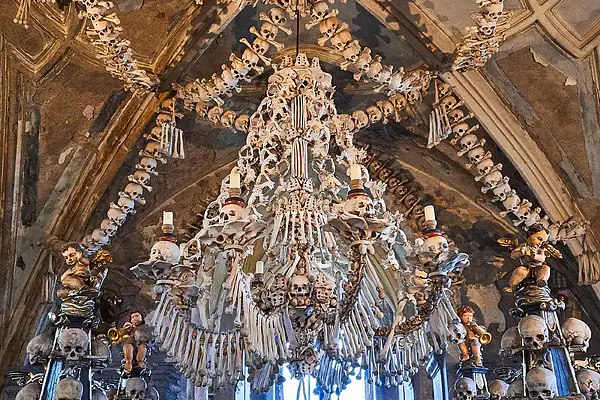
Beneath the Cemetery Church of All Saints in Sedlec, on the outskirts of the medieval silver-mining city of Kutna Hora, lies one of the most extraordinary and unsettling places on Earth. The Sedlec Ossuary contains the bones of an estimated 40,000 to 70,000 human beings, meticulously arranged into decorations, furnishings, and works of art that transform death itself into a medium of aesthetic expression. The ossuary's origins lie in the thirteenth century, when Abbot Henry of the Sedlec Cistercian monastery returned from a pilgrimage to the Holy Land carrying a small amount of earth from Golgotha, the hill where Christ was crucified. He scattered this sacred soil over the monastery cemetery, and word spread across Central Europe that burial in Sedlec meant burial in holy ground. The cemetery became one of the most desirable burial sites on the continent. The Black Death of 1348 and the Hussite Wars of the fifteenth century filled the cemetery far beyond capacity. An estimated 30,000 plague victims and thousands of war dead were buried in ground that could no longer contain them. When new construction required the exhumation of older graves, the bones were placed in the crypt of the chapel. A half-blind Cistercian monk was tasked with organizing them, creating the first pyramidal stacks. In 1870, the Schwarzenberg family, who had acquired the property, hired a local woodcarver named Frantisek Rint to bring artistic order to the accumulation. What Rint created defies easy description: a massive chandelier containing at least one of every bone in the human body, garlands of skulls draped between the pillars, a Schwarzenberg coat of arms rendered entirely in bone, monstrance-shaped arrangements, bell-shaped piles, and countless other configurations that transform human remains into baroque ornamentation. Rint even signed his work in bones, his name spelled out on the wall near the entrance. The effect on visitors is complex and profound. Horror, fascination, reverence, and a strange beauty coexist in a space that forces confrontation with mortality on a scale few other places achieve.
Historical Significance
“Sedlec Ossuary is unique in the world. While ossuaries exist across Europe, from the Catacombs of Paris to the Capuchin Crypt in Rome, none approaches the artistic ambition and scale of Sedlec. Frantisek Rint did not merely store bones; he used them as a medium, transforming the remains of tens of thousands of anonymous dead into objects of terrible beauty. The ossuary is part of the UNESCO-listed Historic Town Centre of Kutna Hora with the Church of St. Barbara and the Cathedral of Our Lady at Sedlec. Kutna Hora was once the second most important city in Bohemia, its wealth built on vast silver mines. The ossuary adds a layer of memento mori to a city whose history is already steeped in the extremes of wealth, plague, and war. For visitors, the ossuary provokes questions that have no comfortable answers. What does it mean to make art from human remains? Is it reverent or sacrilegious? Beautiful or grotesque? The bones themselves offer no opinion. They simply are, arranged in patterns that will outlast the living who gaze upon them.”
物語
1History
👑 Built by
Cistercian monastery (original); Frantisek Rint (bone arrangements, 1870)
1142 - Cistercian monastery founded at Sedlec
1278 - Abbot Henry brings soil from Golgotha to the cemetery
1348-1350 - Black Death fills cemetery with approximately 30,000 dead
1400s - Hussite Wars add thousands more burials
~1400 - Gothic chapel constructed, bones begin accumulating in lower level
1511 - Half-blind monk begins organizing exhumed bones into pyramidal stacks
1703-1710 - Upper chapel rebuilt in Baroque Gothic style by Jan Blazej Santini-Aichel
1870 - Frantisek Rint hired to artistically arrange the bones
1995 - Sedlec and Kutna Hora inscribed as UNESCO World Heritage Site
2020 - Major restoration begins to preserve bone arrangements