
About
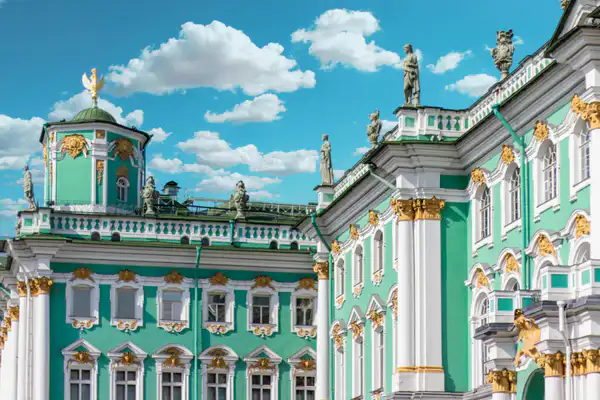
The State Hermitage Museum is one of the largest and most prestigious art museums in the world, housing over 3 million works of art and cultural artifacts in a complex of six magnificent buildings along the Neva River embankment. At its heart stands the Winter Palace — the former residence of Russian emperors, a Baroque masterpiece of 1,057 rooms, 1,945 windows, and 117 staircases. Founded by Catherine the Great in 1764, when she acquired a collection of 225 paintings from Berlin merchant Johann Ernst Gotzkowsky, the Hermitage grew over two and a half centuries into a collection that rivals the Louvre and the British Museum. Its holdings span from Egyptian mummies to Impressionist masterpieces, from Scythian gold to Rembrandt's greatest works. The Winter Palace itself, designed by Bartolomeo Francesco Rastrelli in the Elizabeth Baroque style, is painted its signature green and white — though it has been repainted in various colors throughout its history. Its Jordan Staircase, the Malachite Room, the Throne Room, and the Gallery of 1812 are among the most opulent interiors ever created. But the Hermitage is more than an art collection. It is a witness to the most dramatic moments in Russian history. It was here that the Bolsheviks stormed through the gates in 1917, ending three centuries of Romanov rule. It was here that the Leningrad blockade nearly destroyed both the building and its irreplaceable contents. And it is here that a colony of cats — maintained since the time of Empress Elizabeth — still patrols the basements, guarding the art from rats as they have for nearly 300 years.
Historical Significance
“...s greatest accumulations of artistic wealth. Catherine the Great's original motivation was competitive — she wanted to rival the collections of European monarchs — but the result transcended politics to become a universal treasure. The museum's significance goes beyond art. The Winter Palace was the stage for some of the most consequential events in modern history. The Bloody Sunday massacre of 1905, when troops fired on peaceful protesters before the palace, ignited the revolutionary movement. The October Revolution of 1917, when Red Guards stormed the palace, ended the Russian Empire and inaugurated the Soviet era. During the Siege of Leningrad (1941-1944), museum staff lived in the freezing basements with over a million objects, refusing to let the collection be destroyed. Many of the greatest works had been evacuated to the Urals, but millions of objects remained. Staff members died of starvation beside the art they protected. Their sacrifice is one of the most extraordinary acts of cultural preservation in human history.”
Истории
1History
👑 Built by
Bartolomeo Francesco Rastrelli (architect); Empress Elizabeth (commissioner); Catherine the Great (museum founder)
1754-1762 - Winter Palace built by Rastrelli for Empress Elizabeth (she died before completion; Peter III moved in)
1764 - Catherine the Great acquires 225 paintings, founding what will become the Hermitage
1771 - Catherine buys the Crozat collection from France (including works by Raphael, Titian, Rembrandt)
1787 - "Small Hermitage" building completed to house the growing collection
1837 - Devastating fire destroys much of the Winter Palace interior; rebuilt in 15 months by 6,000 workers
1852 - "New Hermitage" opens as Russia's first public art museum
1905 - Bloody Sunday: troops fire on peaceful workers before the Winter Palace, killing over 100
1917 - Bolsheviks storm the Winter Palace on October 25-26, arresting the Provisional Government
1918 - Museum nationalized; private aristocratic collections added (doubling holdings)
1941-1944 - Siege of Leningrad: 1.2 million objects evacuated; staff live in freezing basements to protect what remains
1945 - Trophies from defeated Germany arrive (including Priam's Treasure from Troy)
1996 - Discovery of Impressionist masterpieces seized from Germany, kept secret for 50 years
2014 - Hermitage opens satellite museums worldwide (Amsterdam, Barcelona)