
About
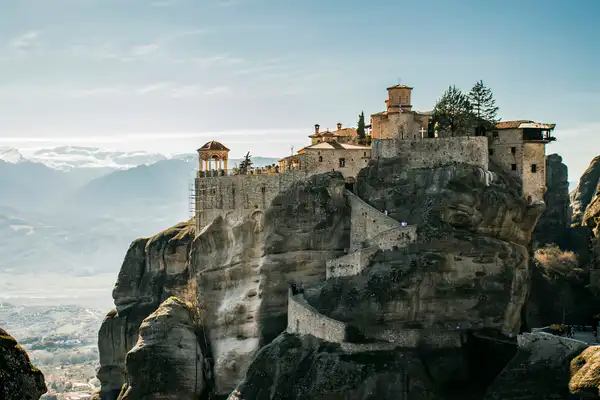
Rising from the Thessalian plain like petrified pillars of a forgotten world, the rock towers of Meteora — whose name means "suspended in air" — bear ancient monasteries built on their impossible summits. These towering sandstone pillars, some reaching over 400 meters above the plain, were formed sixty million years ago when an ancient sea receded, leaving behind columns of stone that erosion sculpted into the otherworldly formations we see today. For medieval monks seeking to escape the world, these rocks offered the ultimate refuge: a place literally between earth and heaven. The first hermits arrived in the 11th century, inhabiting shallow caves and rock fissures high on the cliff faces. They lived in absolute solitude, descending only occasionally for supplies, spending their days in prayer and contemplation in a landscape that seemed to belong more to the realm of angels than of men. But the true transformation of Meteora began in the 14th century, when Saint Athanasios the Meteorite — a monk from Mount Athos — ascended the Great Rock (Platys Lithos) and established the first organized monastery, the Great Meteoron. At their peak in the 16th century, twenty-four monasteries crowned the rock pillars of Meteora, creating one of the most extraordinary monastic communities in Christendom. Access was deliberately perilous: monks were hauled up in rope nets suspended from wooden windlasses, swaying hundreds of meters above the ground. When visitors asked how often the ropes were replaced, the monks answered: "When the Lord lets them break." This was not negligence but theology — every ascent was an act of faith, a literal placing of one's life in the hands of God. The monasteries served as more than spiritual retreats. During the Ottoman conquest of Greece, they became fortresses of Greek identity, preserving manuscripts, icons, and the traditions of Orthodox Christianity through centuries of foreign rule. Monks copied ancient texts by hand, illuminated manuscripts with gold leaf, and maintained schools that kept Greek learning alive when it might otherwise have been extinguished. Today, six monasteries remain active: the Great Meteoron, Varlaam, Rousanou, St. Nicholas Anapausas, St. Stephen, and Holy Trinity. They preserve extraordinary Byzantine frescoes, rare manuscripts, and a living monastic tradition that has continued without interruption for over seven hundred years. UNESCO designated Meteora a World Heritage Site in 1988, recognizing it as an outstanding example of the harmonious integration of human creative achievement with natural beauty.
Historical Significance
“Meteora represents the second most important center of Eastern Orthodox monasticism after Mount Athos, and arguably the most visually dramatic monastic settlement in the world. Its significance extends across religious, cultural, architectural, and geological dimensions, creating a site of unparalleled complexity. The religious importance of Meteora cannot be overstated. The monasteries were conceived as earthly approximations of heaven — places where monks could withdraw from the corruption of the world and devote themselves entirely to God. The physical difficulty of reaching the summits was not an obstacle but a spiritual exercise: the perilous ascent in rope nets was a metaphor for the soul's journey toward the divine. Every aspect of monastic life at Meteora was shaped by this theology of ascent. Architecturally, Meteora represents a triumph of human ingenuity over impossible terrain. The monks built churches, refectories, dormitories, storage rooms, and even gardens on rock surfaces that seemed to offer no foundation. They hauled building materials up in nets and baskets, carved cisterns into the rock to collect rainwater, and developed sophisticated systems for storing food through long winters. The frescoes that adorn these churches — particularly the works of the 16th-century Cretan master Theophanes Strelitzas (Theophanes Bathas) — rank among the finest examples of post-Byzantine art. During the Ottoman period (1453-1821), the monasteries served as repositories of Greek culture. While much of Greece lived under Ottoman administration, the monks of Meteora preserved Greek manuscripts, maintained schools, and provided a continuous link to the Byzantine intellectual tradition. Codices, chrysobulls (imperial documents sealed in gold), and illuminated manuscripts were safeguarded within the monastery libraries, many of which survive today. The geological significance is equally remarkable. The rock pillars of Meteora are composed of a mixture of sandstone and conglomerate, formed approximately 60 million years ago as sediment from rivers flowing into a large delta at the edge of an inland sea. Over millions of years, tectonic activity uplifted the seabed, and erosion carved the plateau into the dramatic pillars visible today. The formations are unique in European geology and continue to attract scientific study.”
Historias
1History
👑 Built by
Byzantine and post-Byzantine monks, beginning with hermits in the 11th century and organized communities from the 14th century
9th century - First recorded hermits inhabit caves in the Meteora rocks
~1020 CE - Small community of hermits establishes regular worship at the Chapel of the Theotokos (Doupiani)
1334 - Athanasios Koinovitis arrives from Mount Athos with 14 monks
1340 - Saint Athanasios the Meteorite ascends the Great Rock and establishes the Monastery of the Great Meteoron
1356 - Serbian Emperor Symeon Urosh Palaiologos (later Ioasaph) joins the monastery, bringing royal patronage
1382 - Ioasaph significantly expands the Great Meteoron after ascending as co-founder
1388 - Monastery of Varlaam founded on the rock where hermit Varlaam had lived decades earlier
1476 - Monastery of Rousanou (St. Barbara) established on a narrow rock pinnacle
1510 - Monastery of St. Nicholas Anapausas built, decorated by Theophanes Strelitzas in 1527
1517 - Brothers Theophanes and Nektarios Apsaras rebuild and expand Varlaam monastery
1545 - Monastery of Holy Trinity completed on one of the most inaccessible pinnacles
16th century peak - Twenty-four active monasteries crown the rocks of Meteora
1788 - Monastery of St. Stephen rebuilt after destruction, becoming a women's convent
1920s - First roads and staircases carved into rock, replacing rope ladders and nets
1988 - UNESCO World Heritage Site designation (mixed cultural and natural criteria)