
About
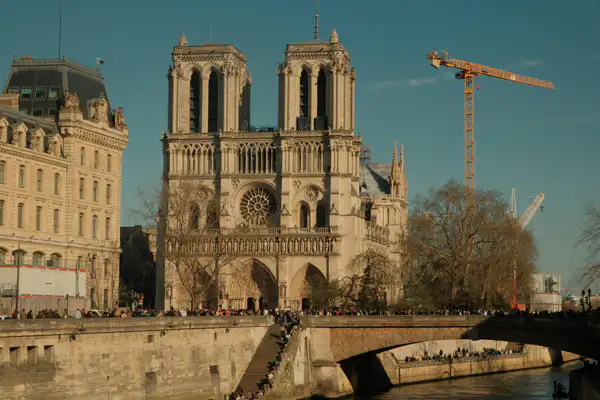
Notre-Dame de Paris is the spiritual heart of France and one of the most beloved buildings in human history — a masterpiece of French Gothic architecture whose twin towers, flying buttresses, rose windows, and gargoyles have defined the image of the medieval cathedral for the entire world. Standing on the Île de la Cité in the center of the Seine, Notre-Dame has witnessed 860 years of French history: coronations, revolutions, liberations, and the devastating fire of 2019 that brought the world to tears. Construction began in 1163 under Bishop Maurice de Sully and was not completed until 1345 — nearly two centuries of continuous building that produced one of the first and finest examples of the Gothic style. The cathedral's innovations were revolutionary: the pointed arch, the ribbed vault, and above all the flying buttresses that allowed the walls to be opened into vast windows of stained glass, flooding the interior with kaleidoscopic light. The three rose windows — the west rose (c. 1225), the north rose (c. 1250), and the south rose (c. 1260) — are among the most magnificent examples of medieval stained glass in existence. Notre-Dame is the point from which all distances in France are measured — the "Point Zéro des Routes de France" is embedded in the pavement before its western portal. It is the symbolic center of the nation, the place where Napoleon crowned himself Emperor, where Charles de Gaulle gave thanks for the liberation of Paris, and where France gathers in its moments of greatest joy and deepest sorrow. The fire of April 15, 2019, which destroyed the spire and much of the roof, was experienced by billions worldwide as a personal loss — as if a beloved character from a novel had died. Victor Hugo, who had saved the cathedral from demolition with his 1831 novel, would perhaps have understood: Notre-Dame is not just stone and glass. It is a living story, perpetually unfinished.
Historical Significance
“Notre-Dame de Paris is arguably the most important Gothic cathedral in the world — not the largest, not the tallest, but the most culturally significant. It established the template for the High Gothic style and became the model for cathedrals across Europe. The cathedral's architectural innovations were genuinely revolutionary. The flying buttresses — those arched exterior supports that look like the ribs of a great stone whale — were among the first of their kind. They transferred the weight of the roof outward, allowing the walls to be pierced by enormous windows that transformed the interior into a luminous space utterly unlike the dark, heavy Romanesque churches that preceded it. This was theology in stone: the medieval idea that God is light, and that a church should be filled with divine illumination. Notre-Dame's cultural significance transcends architecture. It is the spiritual epicenter of French Catholicism — the seat of the Archbishop of Paris, the setting for royal ceremonies, and the place where the nation gathers in crisis. When Paris was liberated in 1944, Charles de Gaulle's first act was to attend a Te Deum at Notre-Dame, even as snipers still fired from the rooftops. Victor Hugo's 1831 novel "Notre-Dame de Paris" (The Hunchback of Notre-Dame) single-handedly saved the cathedral from planned demolition, sparking a preservation movement that led to Viollet-le-Duc's major 19th-century restoration — including the addition of the famous spire that would burn in 2019. Hugo used fiction to create public sentiment for preservation, proving that stories can save buildings as surely as buttresses.”
故事
4History
👑 Built by
Bishop Maurice de Sully (initiated 1163)
1163 - Pope Alexander III lays the first stone; Bishop Maurice de Sully oversees construction
1182 - Choir completed; first services held
1225 - Western rose window completed (one of the finest in Gothic art)
1250 - North rose window installed; twin towers completed c. 1250
1345 - Construction essentially completed after 182 years
1431 - Henry VI of England crowned King of France at Notre-Dame during Hundred Years' War
1572 - Henry of Navarre (future Henry IV) marries Marguerite de Valois; St. Bartholomew's Day Massacre follows
1793 - French Revolution: cathedral ransacked, "Temple of Reason" declared, statues beheaded
1804 - Napoleon I crowns himself Emperor at Notre-Dame
1831 - Victor Hugo publishes "Notre-Dame de Paris," saving the cathedral from demolition
1844-1864 - Major restoration by Eugène Viollet-le-Duc, who adds the famous spire
1944 - Liberation of Paris: Charles de Gaulle attends thanksgiving service amid sniper fire
2019 - April 15: Devastating fire destroys spire and much of the medieval roof; Crown of Thorns saved
2024 - Cathedral reopened after reconstruction