
About
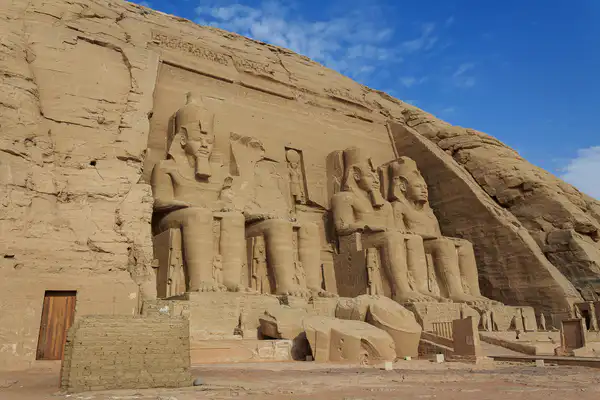
beloved Great Royal Wife, Queen Nefertari. Carved directly into a sandstone cliff face during the 13th century BC, the temples were designed not only as places of worship but as an overwhelming display of Egyptian power aimed at impressing the Nubian population to the south. The four 20-meter statues of Ramesses at the entrance of the Great Temple are among the largest surviving sculptures from antiquity, their serene faces gazing eastward across the waters toward the rising sun. Smaller figures of the pharaoh's family — his mother Muttuya, his wife Nefertari, and several of his children — stand between and beside the colossal legs, dwarfed by the scale of the king. In the 1960s, the temples faced destruction by the rising waters of Lake Nasser created by the Aswan High Dam. In one of the most ambitious engineering feats of the 20th century, an international UNESCO campaign dismantled the entire complex and reassembled it 65 meters higher on an artificial cliff, preserving these irreplaceable monuments for future generations while maintaining their solar alignment to within a single day of the original.
Historical Significance
“Abu Simbel represents the apex of Ramesses II's monumental building program and one of the most ambitious architectural achievements of the ancient world. The temples took approximately twenty years to complete (c. 1264-1244 BC) and served a dual purpose: as a temple dedicated to the principal deities of the Egyptian state and as a spectacular propaganda tool designed to project Egyptian power into Nubia, which had been conquered and colonized during the New Kingdom. The Great Temple's most remarkable feature is its astronomical alignment. Twice a year — on approximately February 22 and October 22, believed to correspond to Ramesses' birthday and coronation day — the first rays of the rising sun penetrate 60 meters through the entrance, across the hypostyle hall, through the vestibule, and into the innermost sanctuary, where they illuminate three of the four seated god-statues: Amun-Ra, Ra-Horakhty, and the deified Ramesses. The fourth statue, representing Ptah, the god of the underworld and darkness, remains perpetually in shadow. This precision alignment, maintained across more than three millennia, demonstrates an extraordinary mastery of astronomy and engineering. The smaller temple dedicated to Nefertari is unique in Egyptian history: it is one of very few instances where a pharaoh dedicated a temple to his queen, and the only known case where the queen's statues on the facade are the same height as the king's — a gesture of remarkable equality in a rigidly hierarchical society. The 1960s UNESCO relocation campaign, involving 50 countries and costing approximately $40 million ($360 million in today's currency), became a defining moment in international heritage preservation and directly inspired the creation of the UNESCO World Heritage Convention in 1972.”
داستانها
3History
👑 Built by
Pharaoh Ramesses II (Ramesses the Great)
c. 1264 BC - Construction begins under Ramesses II
c. 1244 BC - Temples completed after approximately 20 years
1813 - Swiss explorer Johann Ludwig Burckhardt discovers the temples buried in sand
1817 - Giovanni Belzoni clears the entrance and enters the Great Temple
1959 - Egypt announces the Aswan High Dam project, threatening Abu Simbel
1960 - UNESCO launches international campaign to save the temples
1964-1968 - Temples cut into 1,036 blocks and relocated 65 meters higher
1968 - Temples reopened at new location on artificial cliff
1979 - UNESCO World Heritage Site inscription (Nubian Monuments from Abu Simbel to Philae)