
About
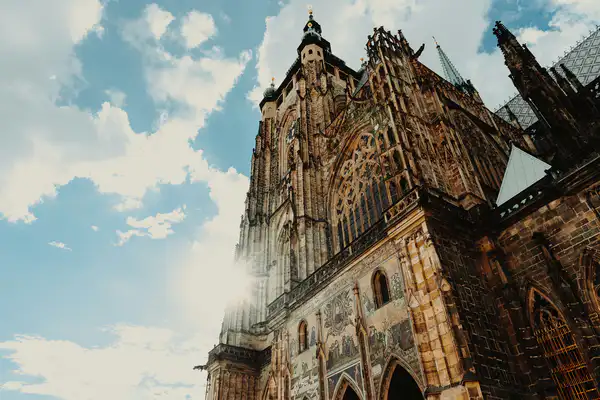
Prague Castle is the largest ancient castle complex in the world, stretching nearly 570 meters in length and 130 meters in width across a ridgeline above the Vltava River. For over eleven centuries it has served as the seat of Czech kings, Holy Roman Emperors, and modern presidents. Its courtyards, cathedrals, palaces, gardens, and towers form a city within a city, layered with Romanesque foundations, Gothic spires, Renaissance loggias, and Baroque facades. The castle's story begins around 880 AD, when Prince Borivoj of the Premyslid dynasty established a fortified settlement on the Hradcany ridge. The earliest stone structures, including the Church of the Virgin Mary and the Basilica of St. George, rose in the 10th century. Over the following millennium, every era left its mark. Charles IV transformed the complex with the magnificent St. Vitus Cathedral. Rudolf II filled its halls with the largest art collection in Europe and turned Prague into the capital of the Holy Roman Empire. The Habsburgs added imperial grandeur. The First Republic's architect Joze Plecnik modernized the gardens and courtyards with an elegance that balanced ancient and modern. Within its walls, the Bohemian Crown Jewels rest behind seven locks held by seven different officials. The cathedral contains the tomb of St. Wenceslas, patron saint of the Czech nation. The Old Royal Palace witnessed the Defenestration of 1618 that ignited the Thirty Years War. Golden Lane preserves the tiny houses where alchemists, goldsmiths, and eventually Franz Kafka once lived and worked. Prague Castle is not merely a monument. It is the living heart of Czech identity, a place where history did not merely happen but continues to unfold.
Historical Significance
“Prague Castle holds the Guinness World Record as the largest coherent castle complex on Earth. Its significance transcends architecture. For Czechs, the castle is the embodiment of statehood itself. When Tomas Garrigue Masaryk became the first president of Czechoslovakia in 1918, his decision to govern from the castle was a deliberate statement: the new republic claimed continuity with a thousand years of Bohemian sovereignty. The castle's role as the seat of the Holy Roman Empire under Charles IV and Rudolf II elevated Prague to a European capital of culture, science, and diplomacy. Rudolf II's court attracted Tycho Brahe, Johannes Kepler, Edward Kelley, and John Dee, making Prague the center of late Renaissance intellectual life. The astronomical, alchemical, and artistic achievements of this period still define the city's identity. The Defenestration of 1618, when Protestant nobles threw Catholic imperial governors from the castle windows, triggered the Thirty Years War, the most devastating conflict in European history before the twentieth century. Prague Castle was thus the stage for an event that reshaped the continent.”
Geschichten
2History
👑 Built by
Prince Borivoj of the Premyslid dynasty (founded ~880 AD)
~880 AD - Prince Borivoj founds the castle on Hradcany ridge
920s - Basilica of St. George constructed
1344 - Construction of St. Vitus Cathedral begins under Charles IV
1383 - Bohemian Crown Jewels placed in St. Vitus Cathedral
1526 - Habsburg dynasty takes control of Bohemia
1583-1611 - Rudolf II makes Prague Castle capital of the Holy Roman Empire
1618 - Second Defenestration of Prague triggers Thirty Years War
1620 - Battle of White Mountain; Czech independence crushed for 300 years
1918 - Castle becomes seat of the Czechoslovak president
1989 - Velvet Revolution; Vaclav Havel enters as president