
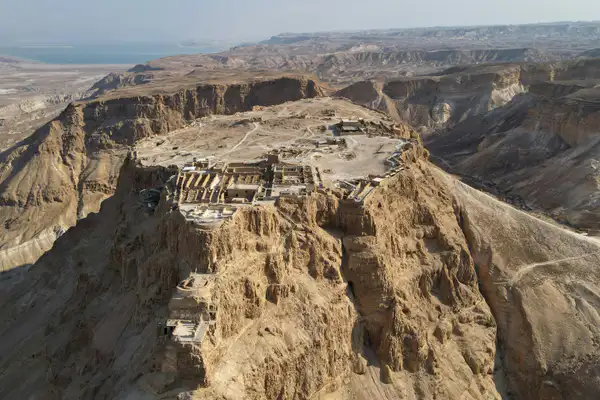
In 1963, Yigael Yadin climbed Masada with thousands of volunteers from twenty-eight countries. Yadin wasn’t just an archaeologist — he’d commanded Israel’s army during its 1948 war of independence. Now he was digging into the desert fortress where, in 73 CE, nearly a thousand Jewish rebels chose death over surrender to Rome. The ancient historian Josephus claimed that on the final night, ten men were chosen by lot to kill everyone else. Yadin wanted to find those lots.
He found something extraordinary. Near the southern gate, his team pulled eleven pottery shards from the dirt — each scratched with a name. One read “Ben Ya’ir.” That was the name of Eleazar ben Ya’ir, the commander who’d convinced his people to choose death over slavery. “We can imagine the feelings of the man who drew the lot,” Yadin wrote. The world was captivated — physical proof of the most dramatic night in Jewish history, right there in the dust.
But scholars pushed back hard. There were eleven shards, not ten as Josephus specified. “Ben Ya’ir” was a common name in the first century — finding it proved nothing, like finding “Smith” at a modern dig. Hundreds of similar name-shards had turned up across Masada, used for mundane things like work rosters and food rations. And Josephus was writing under the sponsorship of the very Roman emperors who’d destroyed Jerusalem. A noble suicide made a far better story than a messy, chaotic end.
Then there were the bodies. In the ruins of the Northern Palace bathhouse, diggers uncovered three skeletons: a young man around twenty, a woman of about eighteen, and a child. Near the woman lay braided hair — still intact after two thousand years, preserved by the bone-dry desert air. She had braided her hair knowing she was about to die. The image was unforgettable. But right nearby lay pig bones. Jews didn’t keep pigs. Romans did. Were these fallen defenders — or Roman soldiers?
Israel answered with politics, not science. In 1969, twenty-seven sets of remains received a full military funeral on the slopes of Masada — flag-draped coffins, honor guard, gun salute. The ceremony treated as fact what archaeology couldn’t prove. Nachman Ben-Yehuda later showed how textbooks quietly erased an ugly truth: the defenders weren’t heroes. They’d massacred seven hundred fellow Jews at a nearby village before fleeing to the mountain. The myth was more useful than the mess.
But the dig also uncovered something no controversy could touch. Among the scrolls in the ruins lay a fragment of Ezekiel 37 — the prophet’s vision of a valley filled with dry bones, where God asks: “Can these bones live?” A passage about national resurrection, found at the exact spot where a nation’s last resistance died. Then, in 2005, scientists planted a date palm seed recovered from Yadin’s dig. Two thousand years old. It sprouted, it grew, and they named the tree Methuselah.
The shards may not be the lots. The bones may not be defenders. The speeches may never have been spoken. But the scrolls were real — read by real people in a real synagogue on a real mountaintop. And that seed was real, buried for two millennia beneath the rubble, waiting for someone to give it water and light. Can these bones live? At Masada, even the seeds say yes.