
About
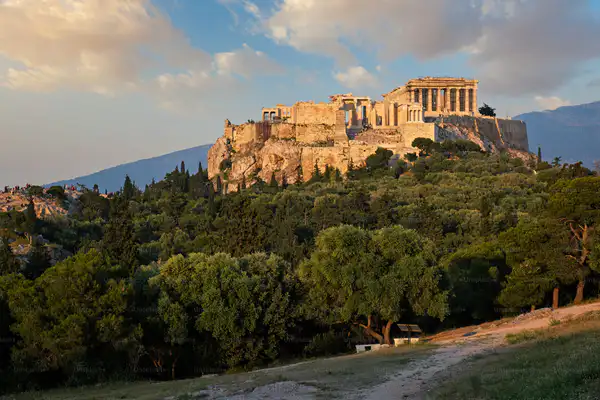
Rising 156 meters above the city of Athens, the Acropolis ("High City") is the most important ancient monument in the Western world — the symbol of classical civilization, democracy, and the philosophical foundations of Western thought. Crowned by the Parthenon, one of the most perfect buildings ever constructed, the Acropolis embodies the achievement of Periclean Athens at its Golden Age. The rocky outcrop was sacred from the beginning. In Mycenaean times, a royal palace stood here, protected by massive Cyclopean walls. By the 8th century BCE, it had become the religious center of Athens, dedicated primarily to Athena, the city's patron goddess. The archaic temples were destroyed when the Persians sacked Athens in 480 BCE, but this destruction became the catalyst for the greatest building program in ancient history. Under the leadership of Pericles, with Phidias as artistic director, the Athenians spent fifty years (447-399 BCE) transforming the Acropolis into an architectural masterpiece. The Parthenon — temple of Athena Parthenos (the Virgin) — was built first, its perfect proportions and optical refinements creating the illusion of mathematical perfection. The Propylaea, a monumental gateway, controlled access to the sacred precinct. The Erechtheion, with its famous Porch of the Caryatids, housed the most ancient and sacred relics of Athens. The Temple of Athena Nike celebrated victory over the Persians. Every aspect of the Acropolis was designed to proclaim Athens' greatness. The sculptures depicted the triumph of civilization over barbarism, of order over chaos, of the Greek over the Persian. The buildings used precise mathematical ratios to achieve their perfection. Even the approach — climbing the steep processional way, passing through the Propylaea, emerging to see the Parthenon gleaming in marble and gold — was choreographed to inspire awe. For over two millennia, the Acropolis has endured: converted to a Byzantine church, then an Ottoman mosque, then an ammunition dump that exploded in 1687, then a subject of archaeological excavation and restoration. Through it all, the Parthenon has stood — damaged, altered, but undefeated — the most enduring symbol of human aspiration toward beauty and truth.
Historical Significance
“The Acropolis represents the apex of ancient Greek civilization and has become the universal symbol of classical culture. Its influence on Western architecture, art, and thought is immeasurable. Every government building with columns, every museum with a triangular pediment, every concept of architectural proportion derives ultimately from the buildings on this rock. The Parthenon, in particular, achieved a perfection that has never been equaled. Its architects incorporated subtle optical refinements — curved lines where straight lines would appear bent, columns that swell slightly at the middle, corner columns that are thicker than the others — to create the illusion of mathematical perfection. These refinements were so subtle that they were not rediscovered until the 19th century, yet they explain why the Parthenon seems more perfect than buildings that are mathematically exact. The sculptures of the Acropolis, many now in the Acropolis Museum and the British Museum (the controversial "Elgin Marbles"), represent the highest achievement of classical Greek art. The Parthenon frieze, depicting the Panathenaic procession, shows ordinary Athenians participating in their civic religion — a democratic statement carved in stone. The pediments depicted the birth of Athena and the contest between Athena and Poseidon for patronage of Athens. The Acropolis was also a political statement. The Parthenon was funded partly by tribute from Athens' allies in the Delian League — money that was supposed to be used for defense against Persia. Pericles justified this "creative accounting" by arguing that Athens had fulfilled its obligation to protect its allies and could use the surplus to glorify the city. The Acropolis thus embodies both the glory and the contradictions of Athenian democracy. Today, the Acropolis remains the most visited archaeological site in Europe, drawing millions who climb the same rock that Socrates, Plato, and Aristotle climbed to visit Athena's shrine.”
Historias
7History
👑 Built by
Pericles (patron); Phidias (artistic director); Ictinus and Callicrates (Parthenon architects)
~1600 BCE - Mycenaean palace and Cyclopean walls constructed
~800 BCE - First temple to Athena built
566 BCE - Great Panathenaea festival established; procession to the Acropolis
480 BCE - Persians destroy the archaic Acropolis
479 BCE - Greeks defeat Persians at Plataea; rubble of old temples buried as memorial
447 BCE - Construction of the Parthenon begins under Pericles
438 BCE - Parthenon completed; gold-and-ivory Athena statue installed
437-432 BCE - Propylaea constructed
427-424 BCE - Temple of Athena Nike constructed
421-406 BCE - Erechtheion constructed
5th century CE - Parthenon converted to Christian church (Church of the Parthenos Mary)
1458 CE - Ottoman conquest; Parthenon converted to mosque
1687 - Venetian bombardment explodes Ottoman ammunition stored in Parthenon
1801-1812 - Lord Elgin removes sculptures (now in British Museum)
1834 - Greek Archaeological Society begins clearing Ottoman additions
1975-present - Major restoration program ongoing
1987 - UNESCO World Heritage Site designation